
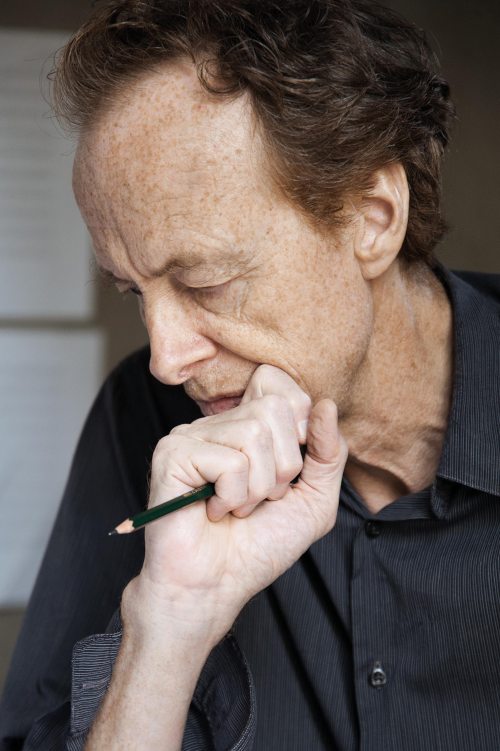

Biography
Beat Furrer was born in Schaffhausen in 1954 and received his first training (piano) at the music school there. After moving to Vienna in 1975, he studied conducting with Otmar Suitner and composition with Roman Haubenstock Ramati at the University of Music and Performing Arts. In 1985 he founded the Klangforum Wien, which he headed until 1992 and which he has been associated with as a conductor ever since. Commissioned by the Vienna State Opera, he wrote his first opera, “Die Blinden”, and his second opera, “Narcissus”, premiered in 1994 at the steirischer herbst at the Graz Opera. In 1996 he was composer in residence at the Lucerne Music Festival. In 2001 the music theater “Begehren” was premiered in Graz, in 2003 the opera “invocation” in Zurich and in 2005 the multi-award winning audio theater “FAMA” in Donaueschingen. Furrer has been full professor of composition at the University of Music and Performing Arts in Graz from 1991 to 2023. At the end of the 1990s, together with Ernst Kovacic, he founded “impuls” as an international ensemble and composer academy for contemporary music in Graz. From 2006 to 2009 he held a visiting professorship for composition at the University of Music and Performing Arts in Frankfurt. In 2004 he received the Music Prize of the City of Vienna, and since 2005 he has been a member of the Academy of Arts in Berlin.
In 2006 he was awarded the Golden Lion at the Venice Biennale for “FAMA”. In 2010, his music theater work “Wüstenbuch” premiered at the Theater Basel. In 2014 he received the great Austrian State Prize. His opera “la bianca notte / the bright night” based on texts by Dino Campana was premiered in Hamburg in May 2015.
Since the 1980s, Furrer has created a broad repertoire ranging from solo and chamber music to works for ensemble, choir, orchestra and opera. In January 2019, his new opera “Violetter Schnee” (Violet Snow), to a libretto by Händl Klaus and based on a template by Vladimir Sorokin, was premiered at the Staatsoper Unter den Linden Berlin.
In August 2024, he was awarded the Roche Commission as part of the Lucerne Festival. In 2025, the opera “Das grosse Feuer” (libretto by Thomas Stangl after the novel “Eisejuaz” by Sara Gallardo) received its world premiere at the Opernhaus Zürich. His second piano concerto was also premiered with the Orchestre de la Suisse Romande conducted by Jonathan Nott and Francesco Piemontesi as the soloist.
Beat Furrer received the Ernst von Siemens Music Prize 2018, he is a member of the Board of Trustees for the New Music Network appointed by the German Federal Cultural Foundation.
Performances
| composer_first_name | composer_last_name | title | date | orchestra | conductor | location | special |
|---|---|---|---|---|---|---|---|
| Antonio | Salieri | Cublai, gran Kan de’ Tartari | 10.08.2026 | Orchestra Haydn di Bolzano e Trento | Stefano Ferrario | La Villa (Badia) | weitere Termine |
| Hector | Berlioz | Grande messe des morts | 15.08.2026 | London Symphony Chorus and Orchestra | Antonio Pappano | London (Proms, Royal Albert Hall) | |
| Wolfgang Amadeus | Mozart | Don Giovanni | 16.08.2026 | Scottish Chamber Chorus and Orchestra | Maxim Emelyanychev | Edinburgh (International Festival) | konzertant |
| Hector | Berlioz | Grande messe des morts | 19.08.2026 | Orquesta Sinfónica de Bilbao | Erick Nielsen | San Sebastian (Musikfestivals Quincena, Auditorio Kursaal) | |
| Wolfgang Amadeus | Mozart | La finta giardiniera | 20.08.2026 | Massimiliano Caldi, Regie: Maria Sartova | Danzig | Premiere | |
| Bernd Alois | Zimmermann | Musique pour les soupers du Roi Ubu | 20.08.2026 | Orchestre des Jardins Musicaux | Valentin Reymond | Cernier | |
| Frank | Martinu | Mass for double choir a cappella | 21.08.2026 | Ensemble Aedes | Mathieu Romano | Vézelay (Basilique Sainte-Marie-Madeleine) | |
| Frank | Martinu | Mass for double choir a cappella | 22.08.2026 | La Tempête | Simon-Pierre Bestion | Souillac (Abbatiale Sainte-Marie) | weitere Termine |
| Felix | Mendelssohn Bartholdy | Die erste Walpurgisnacht | 22.08.2026 | MDR-Sinfonieorchester & MDR Chor | Josep Vila i Casanas | Jena (Volkshaus) | |
| Beat | Furrer | Canti della tenebra, In mia vita da vuolp, Presto für Flöte und Klavier, Melodie für Flöte solo, Studie für Klavier | 26.08.2026 | Elina Viluma-Helling (Sopran), Cornelia Sonnleithner (Alt), Maria Iazia (Klavier) Iva Kovac (Flöte), Gerald Preinfalk (Saxophon) | St. Gallen (Burg Gallenstein) | ||
| Joseph | Haydn | Orlando Paladino | 28.08.2026 | Orfeo Orchestra | György Vashegyi | Fertöd (Haydneum Concerts at Esterházy Palace) | |
| Anton | Bruckner | 9. Symphonie | 28.08.2026 | London Symphony Orchestra | Sir Antonio Pappano | Snape (Maltings Concert Hall) | weitere Termine |
| Hector | Berlioz | La damnation de Faust | 30.08.2026 | Choeur de Radio France, Les Siècles | Jakob Lehmann | London (BBC Proms) | konzertant |
| Joseph | Haydn | L´isola disabitata | 30.08.2026 | Orkest van de XVIIIe Eeuw | Oldenburg | ||
| Hector | Berlioz | Orphée | 01.09.2026 | Chor und Symphonisches Orchester der Opera Ballet Vlaanderen | Francesco Corti | Antwerpen | |
| Camille | Saint-Saëns | Samson et Dalila | 03.09.2026 | National Forum of Music | Thomas Guggeis | Wroclaw (Orlen Main Hall) | |
| Gustav | Holst | The Planets | 03.09.2026 | Robert Schumann Philharmonie | Benjamin Reiners | Chemnitz | |
| Anton | Bruckner | 4. Sinfonie | 08.09.2026 | Staatskapelle Berlin | Christian Thielemann | Berlin (Philharmonie) | |
| Jules | Massenet | Werther | 11.09.2026 | Marie Jacquot, Regie: Tatjana Gürbaca | Kopenhagen | Premiere | |
| Siegfried Schäfer / | Guido Masanetz | Auszüge aus Verlieb‘ dich nicht in eine Heilige/In Frisco ist der Teufel los | 11.09.2026 | Loh-Orchester Sondershausen | Annalena Hoesel | Nordhausen | konzertant, weitere Termine |
| Dieter | Ammann | pRESTO sOSTINATO | 12.09.2026 | Ensemble Modern & Ensemble TIMF | Michael Wendeberg | Tongyeong (Concert Hall) | |
| Eric | Coates | Calling All Workers | 12.09.2026 | Bad Reichenhaller Philharmoniker | Daniel Spaw | Bad Reichenhall (Königliches Kurhaus) | |
| Andreas N. | Tarkmann | Die verlorene Melodie | 12.09.2026 | Staatskapelle Weimar | Weimar (Theaterfest) | ||
| Wolfgang Amadeus | Mozart | Così fan tutte | 12.09.2026 | Sebastiano Rolli, Regie: Martina Gredler | Magdeburg | Premiere | |
| Anton | Bruckner | 3. Symphonie | 13.09.2026 | Orchestre de l'opéra de Lyon | Daniele Rustioni | Lyon | |
| Régis | Campo | Lumen | 13.09.2026 | Stuttgarter Philharmoniker | Rémy Ballot | Besancon (Festival de Musique) | |
| Arnold | Bax | Octet | 14.09.2026 | Ensemble Kontrapunkte | Gottfried Rabl | Wien (Musikverein) | |
| Dieter | Ammann | Boost | 16.09.2026 | Tonhalle-Orchester | Paavo Järvi | Zürich (Tonhalle) | |
| Anton | Bruckner | 3. Symphonie | 17.09.2026 | Essener Philharmoniker | Bertrand de Billy | Essen (Alfried Krupp Saal) | |
| Anton | Bruckner | 8. Symphonie in c-Moll | 17.09.2026 | Gewandhausorchester | Herbert Blomstedt | Leipzig (Gewandhaus) | |
| Andreas N. | Tarkmann | Na warte, sagte Schwarte | 17.09.2026 | Reinhild Köhncke (Sprecherin), Mitglieder Mecklenburgische Staatskapelle | Hang Che | Schwerin (M*Halle) | weitere Termine |
| Ambroise | Thomas | Hamlet | 18.09.2026 | Michael Schönwandt, Regie: Krzysztof Warlikowski | Paris (Opéra National) | Premiere | |
| Wolfgang Amadeus | Mozart | Così fan tutte | 19.09.2026 | Royal Northern Sinfonia | Dinis Sousa | Gateshead (The Sage) | konzertant |
| Wolfgang Amadeus | Mozart | Le nozze di Figaro | 19.09.2026 | Andreas Wolf, Regie: Walter Sutcliffe | Halle | Premiere | |
| Wolfgang Amadeus | Mozart | Die Zauberflöte | 20.09.2026 | Tarmo Peltokoski, Regie: Daniele Finzi Pasca | Zürich | Premiere | |
| Dieter | Ammann | Violation | 20.09.2026 | Tonhalle-Orchester | Julia Kurzydlak | Zürich (Tonhalle) | |
| Georges | Bizet | Carmen | 20.09.2026 | Chris Stark, Regie: Harry Fehr | London (Blackheath Halls) | Premiere | |
| Philipp | Maintz | choralvorspiel XXXIII (in te domine speravi) für orgel solo | 20.09.2026 | Roman Summereder (Orgel) | Hannover (Nazarethkirche) | Uraufführung | |
| Antonín | Dvorák | Rusalka | 22.09.2026 | Giacomo Sagripanti, Regie: Stefano Poda | Toulouse | Premiere | |
| Philipp | Maintz | choralvorspiel VIII (aus tiefer not schrei ich zu dir), choralvorspiel XL (te deum laudamus), choralvorspiel XLVI (morgenglanz der ewigkeit), choralvorspiel LI (kyrie XI, orbis factor) | 23.09.2026 | Hansjörg Albrecht (Orgel) | Berlin (Kathedrale St. Hedwig) | Uraufführung (choralvorspiel VIII) | |
| Andrea Lorenzo | Scartazzini | Brucknerblume für Orgel | 23.09.2026 | Hansjörg Albrecht (Orgel) | Berlin (Kathedrale St. Hedwig) | ||
| Hector | Berlioz | Harold en Italie | 23.09.2026 | Timothy Ridout (Viola), Scottish Chamber Choir | Maxim Emelyanychev | Perth (Concert Hall) | |
| Wolfgang Amadeus | Mozart | Mitridate, re di Ponto | 24.09.2026 | Riccardo Frizza, Regie: Claus Guth | Neapel | Premiere | |
| Andreas N. | Tarkmann | Die Prinzession auf der Erbst | 24.09.2026 | Stephan Hübner (Sprecher), Staatsorchester Darmstadt | Guillaume Fauchère | Darmstadt | auch 25.9. |
| Wolfgang Amadeus | Mozart | Die Zauberflöte | 25.09.2026 | Gianluca Martinenghi, Regie: Hugo de Ana | Sassari | Premiere | |
| Peter | Sculthorpe | Sun Music II | 25.09.2026 | Göttinger Symphonieorchester | Nicholas Milton | Göttingen (Stadthalle) | |
| Matthias | Pintscher | NUR | 25.09.2026 | Inon Barnatan (Klavier), Utah Symphony | Matthias Pintscher | Salt Lake City (Abravanel Hall) | |
| Lubica | Cekovská | At Béla's Window | 25.09.2026 | Slovak Radio Symphony Orchestra | Rastislav Štúr | Bratislava (Grand Concert Hall of Slovak Radio) | |
| Jules | Massenet | Werther | 25.09.2026 | Jakub Przybicien, Regie: Matthias Kitter | Nordhausen | Premiere | |
| Hector | Berlioz | La damnation de Faust | 26.09.2026 | Johannes Braun, Regie: Lorenzo Fioroni | Graz | Premiere | |
| Anders | Hillborg | Cello Concerto | 26.09.2026 | Ariel Barnes (Cello), Nürnberger Symphoniker | Jonathan Darlington | Nürnberg (Meistersingerhalle) | |
| Arnold | Bax | Tintagel | 28.09.2026 | Philharmonisches Orchester Bremerhaven | Florian Ludwig | Bremerhaven | |
| Beat | Furrer | Pedro Beriso | 29.09.2026 | Ulfried Staber (Bass), Gerald Preinfalk (Saxophon) | Graz (BRUSEUM/Neue Galerie) | Uraufführung | |
| Wolfgang Amadeus | Mozart | Zaide | 30.09.2026 | George Petrou, Regie: David Hermann | Frankfurt | Premiere | |
| Anton | Bruckner | 7. Symphonie | 01.10.2026 | Orchestra del Maggio Musicale Fiorentino | Thomas Guggeis | Florenz | |
| George | Benjamin | At first Light | 02.10.2026 | Ensemble Modern Akademie | Wolfenbüttel (Landesmusikakademie Niedersachsen) | ||
| Anton | Bruckner | 2. Symphonie | 02.10.2026 | Deutsche Staatsphilharmonie Rheinland-Pfalz | Christoph Eschenbach | Trier (Ehem. Reichsabtei St. Maximin) | |
| Andrea Lorenzo | Scartazzini | Einklang | 02.10.2026 | Jenaer Philharmonie | Simon Gaudenz | Jena (Volkshaus) | |
| Georges | Bizet | Carmen | 02.10.2026 | Michele Spotti, Regie: Ted Huffman | Valencia (Palau de les Arts Reina Sofia) | Premiere | |
| Wolfgang Amadeus | Mozart | Idomeneo | 02.10.2026 | Stefan Vladar, Regie: Philipp Himmelmann | Lübeck | Premiere | |
| Pietro Mascagni / | Ruggero Leoncavallo | Cavalleria Rusticana/Pagliacci | 03.10.2026 | Sebastian Lang-Lessing, Regie: Pamela Recinella | Hagen | Premiere | |
| Jules | Massenet | Werther | 03.10.2026 | Chloé Dufresne, Regie: Ted Huffman | Rennes | Premiere | |
| Umberto | Giordano | Andrea Chénier | 03.10.2026 | Daniel Cohen, Regie: John Dew | Darmstadt | Premiere | |
| Peter I. | Tschaikowsky | Dornröschen | 03.10.2026 | Carlo Benedetto Cimento, Choreographie: Reginaldo Oliveira | Palermo (Teatro Massimo) | Premiere | |
| Fromental | Halévy | La Juive | 03.10.2026 | Felix Bender, Regie: Marco Storman | Ulm | Premiere | |
| Anton | Bruckner | 5. Symphonie | 04.10.2026 | Philharmonia Orchestra | Herbert Blomstedt | London (Royal Festival Hall) | |
| Jacques | Offenbach | Les contes d'Hoffmann | 04.10.2026 | Sejoon Park, Regie: Anja Nicklich | Koblenz | Premiere | |
| Georg Friedrich | Händel | Alcina | 06.10.2026 | Emmanuelle Haim, Regie: Ewelina Marciniak | Lille | Premiere | |
| Andreas N. | Tarkmann | Wesendonck-Lieder | 08.10.2026 | Lapland Chamber Orchestra | Simon Rivard | Rovaniemi (Korundi) | |
| Manfred | Trojahn | ... mit durchscheinender Melancholie | 08.10.2026 | Hochschulorchester | Hamburg (Hochschule für Musik und Theater) | auch 9.10. | |
| Miroslav | Srnka | Superorganisms 1-4 | 09.10.2026 | Los Angeles Philharmonic | Susanna Mälkki | Los Angeles (Walt Disney Concert Hall) | |
| Georg Friedrich | Händel | Alcina | 09.10.2026 | Orchestra del Teatro di San Carlo | Iván López-Reynoso | Neapel (Teatro di San Carlo) | konzertant |
| Anton | Bruckner | 9. Symphonie | 10.10.2026 | Bamberger Symphoniker | Manfred Honeck | Bamberg (Konzerthalle) | |
| Christoph Willibald | Gluck | Orphée et Eurydice | 10.10.2026 | Alphonse Cemin, Regie: Lorraine de Sagazan | Nantes (Théâtre Graslin) | Premiere | |
| Jonathan | Harvey | Bird Concerto with Pianosong | 10.10.2026 | Antoine Francoise (Piano), Ensemble Contrechamps | Gregory Charette | Genf (Auditorium Ansermet) | |
| Peter I. | Tschaikowsky | Eugen Onegin | 10.10.2026 | Hermes Helfricht, Regie: Matthew Ferraro | Erfurt | Premiere | |
| Beat | Furrer | Herbst, Enigma I-IV & VI, Enigma V, Enigma VII | 10.10.2026 | Cantando Admont | Cordula Bürgi | Graz (Helmut List Halle) | |
| Georg Friedrich | Händel | Ottone | 11.10.2026 | Václav Luks, Regie: Jetske Mijnssen | Frankfurt | Premiere | |
| Wolfgang Amadeus | Mozart | Le nozze di Figaro | 13.10.2026 | Pablo González, Regie: Marta Pazos | Teneriffa (Auditorio) | Premiere | |
| Georg Friedrich | Händel | Riccardo primo, Re d’Inghilterra | 14.10.2026 | Les Arts Florissants | Paul Agnew | Dijon (Grand Théatre) | weitere Termine |
| Andrea Lorenzo | Scartazzini | Torso - Epitaph | 14.10.2026 | Luzerner Sinfonieorchester | Michael Sanderling | Luzern (KKL) | auch 15.10. |
| Andrea Lorenzo | Scartazzini | Brucknerblume für Orgel | 14.10.2026 | Daniel Baker (Orgel) | Luzern (KKL) | auch 15.10. | |
| Anton | Bruckner | 3. Symphonie | 15.10.2026 | Philharmonisches Orchester Erfurt | Hermes Helfricht | Erfurt | |
| Francesco | Filidei | Puccini alla caccia | 15.10.2026 | Studierende der HKB - Musik | Brian Archinal | Bern (Fachhochschule BFH) | |
| Beat | Furrer | Konzert für Klavier und Orchester | 15.10.2026 | Orquesta Sinfónica de l'ESMUC | Ernest Martínez Izquierdo | Barcelona | |
| Gioachino | Rossini | Il barbiere di Siviglia | 15.10.2026 | Chloe Rooke, Regie: Annabel Arden | Glyndebourne (Opera Festival) | Premiere | |
| Bernd Alois | Zimmermann | Musique pour les soupers du Roi Ubu | 15.10.2026 | Münchner Philharmoniker | Anja Bihlmaier | München (Isarphilharmonie) | |
| Torsten | Rasch | Die wunderbaren Jahre | 16.10.2026 | Christian Blex, Regie: Nora Bussenius | Dresden | Premiere | |
| Camille | Saint-Saëns | Samson et Dalila | 17.10.2026 | Kiril Stankow, Regie: Thomas Schmidt-Ehrenberg | Schwerin (Theaterzelt am Küchengarten) | Premiere | |
| Anton | Bruckner | 5. Symphonie | 17.10.2026 | NHK Symphony Orchestra | Matthias Bamert | Tokio (NHK Hall) | |
| Salvatore | Sciarrino | Gesualdo senza parole | 17.10.2026 | Klangforum Wien | Sylvain Cambreling | Wien (Konzerthaus) | |
| Charles | Gounod | Faust | 20.10.2026 | Daniele Rustioni, Regie: Johannes Erath | Mailand (Teatro alla Scala) | Premiere | |
| Anton | Bruckner | Symphonie f-Moll | 22.10.2026 | Symphonieorchester des Bayerischen Rundfunks | Simone Young | München (Residenz) | |
| Ruggiero | Leoncavallo | La Bohème | 22.10.2026 | Chor und Orchester der Oper Graz | Daniela Musca | Graz | konzertant |
| Dieter | Ammann | Viola Concerto „No templates“ | 23.10.2026 | John Stulz (Viola), Ensemble Intercontemporain | George Benjamin | Paris (Cité de la Musique) | |
| Georg Friedrich | Händel | Flavio, Re de’ Langobardi | 23.10.2026 | Camille Delaforge, Regie: Max Emanuel Cencic | Meiningen | Premiere | |
| Georg Friedrich | Händel | Semele | 23.10.2026 | Orchestra e Coro del Teatro Comunale di Bologna | Rinaldo Alessandrini | Bologna (Teatro Comunale) | konzertant |
| Georg Friedrich | Händel | Occasional Oratorio | 24.10.2026 | La strada armónica | Matthias Beckert | Würzburg (KdöR) | |
| Benjamin | Britten | Young Apollo | 24.10.2026 | Camerata Bern | Alexander Melnikov | Bern (Zentrum Paul Klee) | |
| Georg Friedrich | Händel | Semele | 25.10.2026 | Orchestra, Coro e Tecnici del Teatro Comunale di Bologna | Rinaldo Alessandrini | Bologna (Teatro Comunale) | |
| Arnold | Bax | Concerto for Flute, Oboe, Harp & String Quartet | 27.10.2026 | Warsaw Philharmonic Orchestra | Warschau (Chamber Music Hall) | ||
| Matthias | Pintscher | Assonanza | 29.10.2026 | Leila Josefowicz (Violine), Royal Stockholm Philharmonic Orchestra | Matthias Pintscher | Stockholm (Konserthuset) | |
| Wolfgang Amadeus | Mozart | Così fan tutte | 29.10.2026 | N.N., Regie: Nilufar K. Münzing | Klagenfurt | Premiere | |
| Dieter | Ammann | glut | 30.10.2026 | Estonian National Symphony Orchestra | Gregor A. Mayrhofer | Tallinn (Festival AFEKT, Estonia Concert Hall) | |
| Pietro Mascagni / | Ruggero Leoncavallo | Cavalleria Rusticana/Pagliacci | 31.10.2026 | Sebastian Lang-Lessing, Regie: Pamela Recinella | Hagen | Premiere | |
| Peter I. | Tschaikowsky | Schwanensee | 31.10.2026 | Camerata Louis Spohr | Bernd Peter Fugelsang | Düsseldorf | |
| Ambroise | Thomas | Hamlet | 01.11.2026 | Chelsea Opera Group | Jonathon Cole-Swinard | London (Cadogan Hall) | |
| Dieter | Ammann | Turn | 04.11.2026 | Tonhalle-Orchester | Paavo Järvi | Zürich (Tonhalle) | auch 5./6.11. |
| Christoph Willibald | Gluck | Iphigénie en Tauride | 06.11.2026 | David Bates, Regie: Lyndsey Turner | London (Coliseum) | Premiere | |
| Anton | Bruckner | 4. Symphonie | 06.11.2026 | Bamberger Symphoniker | Jakub Hrusa | Brünn (Janácek-Theater) | |
| Dieter | Ammann | glut | 06.11.2026 | hr-Sinfonieorchester | Michael Wendeberg | Frankfurt (hr-Sendesaal) | |
| Dieter | Ammann | Core | 07.11.2026 | Orchester der Oper Zürich | Gianandrea Noseda | Zürich | |
| Pietro | Mascagni | Cavalleria rusticana | 07.11.2026 | Vito Cristofaro, Regie: Gil Mehmert | Dortmund | Premiere | |
| Beat | Furrer | Neues Werk für Orchester | 07.11.2026 | Kammerorchester Basel | Pierre Bleuse | Basel (Stadtcasino) | Uraufführung |
| Hector | Berlioz | Grande messe des morts | 08.11.2026 | Wiener Symphoniker | Maxime Pascal | Wien (Musikverein) | |
| Engelbert | Humperdinck | Dornröschen | 08.11.2026 | Markus Poschner, Regie: Anna Bergmann | Hamburg | Premiere | |
| Wolfgang Amadeus | Mozart | La clemenza di Tito | 13.11.2026 | Ottavio Dantone, Regie: Chiara Muti | Ravenna (Ravenna Festival) | Premiere | |
| Camille | Saint-Saëns | Samson et Dalila | 13.11.2026 | Orchestra e Coro del Teatro Comunale di Bologna | Roberto Abbado | Bologna (Teatro Comunale) | konzertant |
| Hector | Berlioz | Orphée | 14.11.2026 | Antony Walker, Regie: José Maria Condemi | Pittsburgh (Byham Theater) | Premiere | |
| Wolfgang Amadeus | Mozart | Die Zauberflöte | 14.11.2026 | Ottavio Dantone, Regie: Chiara Muti | Ravenna (Ravenna Festival) | Premiere | |
| Wolfgang Amadeus | Mozart | Le nozze di Figaro | 14.11.2026 | Danyil Ilkiv, Regie: Marijke Malitius | Passau | Premiere | |
| Beat | Furrer | a sei voci für 6 Frauenstimmen | 15.11.2026 | Cantando Admont | Cordula Bürgi | Münchendorf (Musiksalon) | |
| Anton | Bruckner | 4. Symphonie | 18.11.2026 | HSO Hochschulsinfonieorchester | Roland Kluttig | Dresden (Hochschule für Musik) | |
| Georg Friedrich | Händel | Agrippina | 21.11.2026 | Gerd Amelung, Regie: Claudia Isabel Martin | Heidelberg | Premiere | |
| Václav | Trojan | Märchen | 21.11.2026 | Kammerorchester der TUD | Florian Streich | Groß-Umstadt (Stadthalle) | |
| Wolfgang Amadeus | Mozart | Le nozze di Figaro | 21.11.2026 | Hélio Vida, Regie: Nikolaus Habjan | Basel | Premiere | |
| Henry | Purcell | Dido and Aeneas | 21.11.2026 | Daniel Geiss, Regie: Seollyeon Konwitschny-Lee | Neubrandenburg | Premiere | |
| Wolfgang Amadeus | Mozart | La clemenza di Tito | 25.11.2026 | David McVicar, Regie: Bettina Neuhaus | Barcelona | Premiere | |
| Wolfgang Amadeus | Mozart | Don Giovanni | 26.11.2026 | Hungarian Philharmonic Orchestra | Giancarlo Andretta | Budapest (Müpa) | konzertant |
| Georg Friedrich | Händel | Agrippina | 27.11.2026 | Constantin Trinks, Regie: Walter Sutcliffe | Sofia | Premiere | |
| Georg Friedrich | Händel | Agrippina | 28.11.2026 | Jinie Ka, Regie: Gregor Horres | Linz (Black Box Musiktheater) | Premiere | |
| Andreas N. | Tarkmann | Das Mondklavier | 29.11.2026 | Beate Bachmann (Sprecherin), Jenaer Philharmonie | Jena (Volkshaus) | ||
| Giovanni | Sollima | Violoncelles, vibrez! | 02.12.2026 | Münchener Kammerorchester | Daniel Giglberger | Olten (Stadttheater) | |
| Dieter | Ammann | Gehörte Form - Hommages | 03.12.2026 | Trio Sola | Zürich (Tonhalle) | ||
| Georges | Bizet | Les Pêcheurs de Perles | 05.12.2026 | Marc Minkowski, Regie: Pierre-André Weitz | Paris (Théâtre des Champs-Elysées) | Premiere | |
| Andreas N. | Tarkmann | Nils Holgersson | 06.12.2026 | Erik Brünner (Sprecher), Jugendsinfonieorchester Heinrich-Schütz-Konservatorium, Dresdner Philharmonie | Milko Kersten | Dresden (Kulturpalast) | auch 7.12. |
| Francesco | Filidei | I funerali dell’anarchico Serantini | 09.12.2026 | Studierende der Hochschule | Karlsruhe (Hochschule für Musik) | ||
| Miroslav | Srnka | Smoke | 10.12.2026 | NHK Symphony Orchestra | Maxim Emelyanychev | Tokio (Suntory Hall) | Uraufführung |
| Wolfgang Amadeus | Mozart | Le nozze di Figaro | 13.12.2026 | Marta Gardolinska, Regie: Jetske Mijnssen | Genf (Bâtiment des Forces Motrices) | Premiere | |
| Hector | Berlioz | La damnation de Faust | 17.12.2026 | Bertrand de Billy, Regie: Lydia Steier | Wien (Staatsoper) | Premiere | |
| Wolfgang Amadeus | Mozart | Così fan tutte | 18.12.2026 | Felix Bender, Regie: David Bösch | Ulm | Premiere | |
| Jules | Massenet | Thaïs | 18.12.2026 | Pierre Dumoussaud, Regie: Olivier Lepelletier-Leeds | Liège | Premiere | |
| Georg Friedrich | Händel | Flavio, Re de’ Langobardi | 19.12.2026 | Karsten Januschke, Regie: Tilmann Köhler | Frankfurt (Bockenheimer Depot) | Premiere | |
| Georges | Bizet | Les Pêcheurs de Perles | 29.12.2026 | Victorien Vanoosten, Regie: Mirabelle Ordinaire | Toulon (Zénith) | Premiere | |
| Wolfgang Amadeus | Mozart | Thamos, König in Ägypten | 12.01.2027 | Orchestra Haydn di Bolzano e Trento | Christophe Rousset | Bozen (Auditorium) | |
| Dieter | Ammann | glut | 13.01.2027 | Tonhalle-Orchester | Gianandrea Noseda | Zürich (Tonhalle) | |
| Jules | Massenet | Werther | 16.01.2027 | Staatsphilharmonie Nürnberg | Christopher Schumann | Nürnberg | konzertant |
| Wolfgang Amadeus | Mozart | La clemenza di Tito | 19.01.2027 | Stefano Montanari, Regie: Rafael R. Villalobos | Valencia | Premiere | |
| Richard | Dubugnon | Sonnenring | 20.01.2027 | Janine Jansen (Violine), Orchestre de la Suisse Romande | Jonathan Nott | Genf (Victoria Hall) | |
| Georg Friedrich | Händel | Orlando | 21.01.2027 | Daniel Espasa, Regie: Rafael Villalobos | Teneriffa (Auditorio) | Premiere | |
| Antonín | Dvorák | Rusalka | 23.01.2027 | Francesco Angelico, Regie: Vasily Barkhatov | Graz | Premiere | |
| Christoph Willibald | Gluck | Orfeo ed Euridice | 23.01.2027 | Eric Staiger, Regie: Aileen Schneider | Oldenburg | Premiere | |
| Engelbert | Humperdinck | Königskinder | 23.01.2027 | Markus Poschner, Regie: Paul-Georg Dittrich | Linz | Premiere | |
| Giovanni | Sollima | When We Were Trees | 24.01.2027 | Südwestdeutsches Kammerorchester | Reto Bieri | Pforzheim (CongressCentrum) | |
| Andreas N. | Tarkmann | Nils Holgersson | 24.01.2027 | Oliver Moumouris (Sprecher), Württembergische Philharmonie | Hans Grischkat | Reutlingen (Georgensaal) | |
| Manfred | Trojahn | Abendröthe | 28.01.2027 | Christian Gerhaher (Bariton), Gerold Huber (Piano) | Kronberg (Kronberg Academy, Casals Forum) | auch 4.2. München | |
| Benjamin | Britten | Young Apollo | 29.01.2027 | Dresdner Philharmonie | Donald Runnicles | Dresden (Kulturpalast) | |
| Christoph Willibald | Gluck | Orfeo ed Euridice | 29.01.2027 | Kirill Gerstein (Klavier), Dresdner Philharmonie | Aapo Häkkinen, Regie: Tero Saarinen | Helsinki | Premiere |
| Engelbert | Humperdinck | Königskinder | 30.01.2027 | Justus Thorau, Regie: Angela Denoke | Saarbrücken | Premiere | |
| Antonín | Dvorák | Rusalka | 30.01.2027 | Jiri Rozen, Regie: Caterina Cianfarini | Basel | Premiere | |
| Wolfgang Amadeus | Mozart | Le nozze di Figaro | 30.01.2027 | Marco Alibrando, Regie: Marcos Darbyshire | Weimar | Premiere | |
| Peter I. | Tschaikowsky | Eugen Onegin | 05.02.2027 | Felix Bender, Regie: Benjamin Künzel | Ulm | Premiere | |
| Wolfgang Amadeus | Mozart | Don Giovanni | 05.02.2027 | Václav Luks, Regie: Jiri Herman | Brünn (Janácek-Theater) | Premiere | |
| Wolfgang Amadeus | Mozart | La clemenza di Tito | 05.02.2027 | John Warner, Regie: Krystian Lader | Gelsenkirchen | Premiere | |
| Jean-Philippe | Rameau | Les Boréades | 05.02.2027 | Camille Delaforge, Regie: R.B. Schlather | Dublin (Irish National Opera) | Premiere | |
| Anton | Bruckner | 8. Symphonie | 06.02.2027 | Gewandhausorchester | Christoph Gedschold | Leipzig (Opernhaus) | |
| Wolfgang Amadeus | Mozart | Così fan tutte | 10.02.2027 | Thomas Hengelbrock, Regie: Netia Jones | London (Royal Opera House) | Premiere | |
| Jules | Massenet | Werther | 11.02.2027 | Nathalie Stutzmann, Regie: Robert Carsen | Paris (Opéra National) | Premiere | |
| Frank | Martinu | Mass for double choir a cappella | 11.02.2027 | BBC Singers and Edvard Grieg Kor | Daniel Hyde | Bergen (Grieghallen) | |
| Henry | Purcell | Dido and Aeneas | 13.02.2027 | Lorenz Höß, Regie: Markus Dietze | Koblenz | Premiere | |
| Wolfgang Amadeus | Mozart | Don Giovanni | 13.02.2027 | Gerrit Prießnitz, Regie: Anna-Sophie Mahler | Innsbruck | Premiere | |
| Camille | Saint-Saëns | Samson et Dalila | 13.02.2027 | Marco Comin, Regie: N.N. | Bremerhaven | Premiere | |
| Ludwig van | Beethoven | Fidelio | 17.02.2027 | Kensho Watanabe, Regie: Ruth Knight | Glasgow | Premiere | |
| Georg Friedrich | Händel | Samson | 18.02.2027 | Monteverdi Chor, Lautten Compagney | Antonius Adamske | Hamburg (Elbphilharmonie) | |
| Georg Friedrich | Händel | Rinaldo | 22.02.2027 | Philippe Jaroussky, Regie: Valentina Carrasco | Paris (Théâtre des Champs-Elysées) | Premiere | |
| Frank | Martinu | Mass for double choir a cappella | 26.02.2027 | Estonian Philharmonic Chamber Choir | Tõnu Kaljuste | Rotterdam (de Doelen) | weitere Termine |
| Dieter | Ammann | unbalanced instability für Violine und Kammerorchester | 25.02.2027 | Carolin Widmann (Violine), Tonhalle-Orchester | Hannu Lintu | Zürich (Tonhalle) | |
| Oliver | Leith | Last Days | 27.02.2027 | André de Ridder, Friedrike Scheunchen, Regie: Lily Kuhlmann | Freiburg | Premiere | |
| Bedrich | Smetana | Die verkaufte Braut | 28.02.2027 | Tómas Netopil, Regie: Laurent Pelly | Köln | Premiere | |
| Wolfgang Amadeus | Mozart | Le nozze di Figaro | 05.03.2027 | Kaspar Zehnder, Regie: Joel Lauwers | Metz | Premiere | |
| Georg Friedrich | Händel | Serse | 06.03.2027 | Clément Lonca, Regie: Lorenzo Fioroni | Bern | Premiere | |
| Ambroise | Thomas | Hamlet | 07.03.2027 | Seok-Won Hong, Regie: Nicola Berloffa | Teneriffa (Auditorio) | Premiere | |
| Andreas N. | Tarkmann | König Karotte | 11.03.2027 | Stephan Hübner (Sprecher), Staatsorchester Darmstadt | Darmstadt | ||
| Georg Friedrich | Händel | Rinaldo | 14.03.2027 | Philippe Jaroussky, Regie: Valentina Carrasco | Zürich | Premiere | |
| Bohuslav | Martinu | Konzert Nr. 2 für Violine und Orchester | 15.03.2027 | Kirill Kobantschenko (Violine), Sinfonia Academica | David Holzinger | Wien (Mozartsaal) | |
| Christoph Willibald | Gluck | Iphigénie en Aulide | 20.03.2027 | Ivan Demidov, Regie: Jochen Biganzoli | Augsburg | Premiere | |
| Charles | Gounod | Faust | 23.03.2027 | Orchestre Symphonique de la Garde républicaine | Bastien Stil | Paris (Théâtre des Champs-Élysées) | konzertant |
| Lubica | Cekovská | Toy Procession for orchestra | 08.04.2027 | Bamberger Symphoniker | Juraj Valcuha | Fulda (Schlosstheater) | auch 10./11.4. Bamberg |
| Georg Friedrich | Händel | Rinaldo | 09.04.2027 | Francesco Corti, Regie: Nadja Loschky | Wien (Theater an der Wien) | Premiere | |
| Wolfgang Amadeus | Mozart | Don Giovanni | 10.04.2027 | Levente Török, Regie: Rahel Thiel | Aachen | Premiere | |
| Andreas N. | Tarkmann | Die verlorene Melodie | 11.04.2027 | Stephan Hübner, Sprecher / Jenaer Philharmonie | Arturs Oskars Mitrevics | Jena (Volkshaus) | |
| Wolfgang Amadeus | Mozart | La clemenza di Tito | 16.04.2027 | N.N., Regie: Hinrich Horstkotte | Meiningen | Premiere | |
| Francesco | Cilèa | L'Arlesiana | 17.04.2027 | Staatskapelle Weimar | Daniel Carter | Weimar | konzertant |
| Bedrich | Smetana | Die verkaufte Braut | 17.04.2027 | N.N., Regie: Maren Schäfer | Krefeld | Premiere | |
| Hector | Berlioz | Orphée | 20.04.2027 | Speranza Scapucci, Regie: Ted Huffman | Paris (Théâtre des Champs-Elysées) | Premiere | |
| Andreas N. | Tarkmann | Die Prinzessin auf der Erbse | 21.04.2027 | Antje Horn (Erzählerin), Meininger Hofkapelle | Meiningen | ||
| Antonín | Dvorák | Rusalka | 23.04.2027 | Daniel Inbal, Regie: Kai Anne Schuhmacher | Pforzheim | Premiere | |
| Lubica | Cekovská | Toy Procession for orchestra | 23.04.2027 | Utah Symphony | Ludovic Morlot | Salt Lake City (Abravanel Hall) | auch 24.4. |
| Georg Friedrich | Händel | Alcina | 24.04.2027 | Pedro Beriso, Regie: Maria Chagina | St. Gallen | Premiere | |
| Ferdinando | Paer | Leonora | 24.04.2027 | Giulio Cilona, Regie: Andrea Moses | Dresden (Semperoper) | Premiere | |
| Georges | Bizet | Carmen | 25.04.2027 | Yorgos Ziavras, Regie: Greg Eldridge | Wuppertal | Premiere | |
| Wolfgang Amadeus | Mozart | Don Giovanni | 30.04.2027 | Gabriel Venzago, Regie: Jan Eßinger | Mainz | Premiere | |
| Engelbert | Humperdinck | Königskinder | 01.05.2027 | Christian Thielemann, Regie: David Bösch | Berlin (Staatsoper unter den Linden) | Premiere | |
| Wolfgang Amadeus | Mozart | La clemenza di Tito | 02.05.2027 | Pavel Baleff, Regie: Jean-Philippe Clarac & Olivier Deloeuil | Limoges | Premiere | |
| Matthias | Pintscher | NUR | 05.05.2027 | Realtime Orchester | Mercedes Diaz Garcia | Bremen (Theater am Leipnizplatz) | |
| Wolfgang Amadeus | Mozart | Die Entführung aus dem Serail | 07.05.2027 | Kaspar Zehnder, Regie: Florent Siaud | Avignon | Premiere | |
| Georg Friedrich | Händel | Alcina | 08.05.2027 | Alessandro Quarta, Regie: Felix Seiler | Kiel | Premiere | |
| Wolfgang Amadeus | Mozart | Die Zauberflöte | 15.05.2027 | Vito Cristofaro, Regie: Georg Heckel | Oldenburg | Premiere | |
| Leos | Janácek | Glagolitische Messe | 20.05.2027 | Prager Philharmonischer Chor, Dresdner Philharmonie | David Robertson | Dresden (Kulturpalast) | |
| Andreas N. | Tarkmann | Jack und die Bohnenranke | 22.05.2027 | Elke Kottmair (Sprecherin), Kärntner Sinfonieorchester | N.N. | Klagenfurt | |
| Dieter | Ammann | Le réseau des reprises | 27.05.2027 | Tonhalle-Orchester | Cristian Macelaru | Zürich (Tonhalle) | |
| Wolfgang Amadeus | Mozart | Don Giovanni | 28.05.2027 | Corinna Niemeyer, Regie: Andrea Bernard | Lausanne | Premiere | |
| Robert | Oboussier | Amphitryon | 29.05.2027 | Daniel Carter, Regie: Kerstin Steeb | Weimar | Premiere | |
| Hector | Berlioz | La damnation de Faust | 05.06.2027 | Sébastien Rouland, Regie: Pierre-Emmanuel Rousseau | Saarbrücken | Premiere | |
| Wolfgang Amadeus | Mozart | Le nozze di Figaro | 05.06.2027 | Maximilian Otto, Regie: Nilufar K. Münzing | Chemnitz | Premiere | |
| Ludwig van | Beethoven | Leonore (1805) | 13.06.2027 | Chorwerk Ruhr, Dresdner Philharmonie | Dorothee Oberlinger | Dresden (Kulturpalast, Musikfestspiele Potsdam Sanssouci) | |
| Camille | Saint-Saëns | Samson et Dalila | 13.06.2027 | Gianandrea Noseda, Regie: Evgeny Titov | Zürich | Premiere | |
| Wolfgang Amadeus | Mozart | Don Giovanni | 16.06.2027 | Kyrian Friedenberg, Regie: Jean-Yves Ruf | Châteauvallon | Premiere | |
| Lubica | Cekovská | Sanctus Adalbertus Oratorio | 16.06.2027 | Slovak Philharmonic Choir, Prague Symphony Orchestra | Tomáš Netopil | Prag (Municipal house) | Uraufführung, auch 20.6. Litomyšl |
| Christoph Willibald | Gluck | Alceste | 25.06.2027 | Titus Engel, Regie: Milo Rau | Stuttgart | Premiere |
Works
A portrait of Beat Furrer
The Drama of Listening
Anyone who wants to get to know Beat Furrer’s music should head directly to the starting point of his tonal fantasy: to the dramatic moment in which the outrageous happens. At the heart of his output lies music theatre work – most recently “Wüstenbuch” (world premiere, Basel 2010), preceded by “FAMA” (Donaueschingen, 2005), “Invocation“ (Zurich, 2003) and “Begehren” (Graz, 2003), as well as “Narcissus” (Graz, 1994) and “Die Blinden” (Vienna, 1989). Around the dramatic work, and closely interwoven with it, are his instrumental works. The compelling power of Beat Furrer’s compositions results from the precision and consistency with which he creates musical symbols for those elementary constellations which stand at the centre of the drama.
Beat Furrer’s music theatre works give audible expression to incredible events. The outrageous instant, the moment of sudden change in a plot is the initial moment and gravitational field for sound and structure: the opera “Invocation” takes as its starting point a cry which cuts into a child’s piano lesson and reveals a murder. In “Fama” it is the distress of a young woman who is forced into prostitution in order to pay her father’s debts. In the original source, Schnitzler’s novella “Fräulein Else”, events culminate in an unparalleled sensation in which Else poisons herself and exposes herself in front of a hotel gathering. At the centre of his first music theatre work, “Die Blinden” after Maeterlinck, comes the shocking moment of realisation that the only sighted person, the leader, lies dead in the middle. Narcissus perishes from the unattainability of the utopian image in the mirror.
The composed glance backwards: “Begehren” [“Desire”]
“Begehren” contains the moment of Orpheus’s ascent from Hades, the realm of darkness, and his fateful turning round. The first scene sets the rushing, sibilant sound of “shadows” in instrumental and vocal sounds, a complex collective of orchestra and chorus performs the movement of ascending in lines layered one on top of another, ascending lines which transform tonally from dark to light and which are projected rotating into the space. The spellbinding reminder “Und wandte mich um” [And I turned around] cuts into the action as a turning point, repeated several times. Several layers of text and language are present: alongside “Der Untröstliche” (The inconsolable) by Pavese there are tales by Ovid and Virgil. The sound is generated from the physicality of the various languages as well as the span between speaking and singing. The poles are personified by the two main figures HE (spoken) and SHE (sung), their sonority meeting only in one, whispered scene. The insuperability of the separation through death is not cancelled out in Begehren: SHE formulates the conclusion: “I can speak to you as if you were here, and yet night lies between us… separation insurmountable more conclusive with every hour…”
Beat Furrer composes the idea of the story condensed into a moment in a complex musical matrix. Its component parts are superimposed over each other and presented or faded out through filters; it is, as it were, projected into space and time. A dramatic conception of simultaneity results which Furrer develops from the narrative in retrospect. By memorising, a story is complete, with development and resolution present, and corresponding with this, the whole drama is already present musically in the opening scene of “Begehren”.
Beat Furrer has developed this process following on from instrumental works such as “nuun” (for two pianos and ensemble, 1996) and still (for ensemble, 1998). In “Begehren” he used it for the first time in combination with a music theatre work. Instrumental works such as “andere stimmen” for violin and orchestra (2003) and “PHAOS” for orchestra (2006) develop these materials further.
The drama of listening: FAMA
A metaphor for the existence of the composer is listening to Fama, the mythical figure whose house is made “entirely from sounding brass” and who is described “with overwhelming sensuousness” by Ovid: “everywhere it reverberates, throws sounds back and repeats what it hears”. According to Beat Furrer, the composer goes through this world and attempts by listening to comprehend events and to analyse their sound. Stories such as those of Orpheus, of Narcissus, of Else, of Anne are those which can resonate in the house of Fama.
In Beat Furrer’s sound theatre piece “FAMA”, the theatrical idea of a place where stories coincide became the starting point for an architecture which is at the same time the listening room (auditorium) and the stage: a cube of moving panels, reflecting or absorbing surfaces around the listener makes it possible to thematise the presence of the sounds, that is the nearness and the distance, the inner and the outer. The voice and language of an actress enter a space in relation to the instrumental and sung vocal sound, which gradually becomes the inner space of the main figure. The text material is Schnitzler’s novella “Fräulein Else”, augmented by Lucretius and Carlo Emilio Gadda. Else’s restless soliloquy is a human fate which resounds in the house of Fama – as a cry, as a despairing whisper, as a breathless stammering. This figure, which is only thought, language, oscillates between being lost in a dream and the entrapped present. Else has been sent into the refined world of a hotel in the Dolomites. She has a despairing matter-of-fact feeling for the path this society prescribes for her, in which women are wearing pearl necklaces like a leash. “If I get married one day, I’ll probably do it more cheaply” – marriage is just another form of prostitution. Else has to get hold of money for her father in debt. The sponsor demands a price which drives her to self-destruction, a further “victim on the altar of a world of total reification” (Furrer). – “How strange my voice sounds” – the voice and its changing sonority draws ever closer in the course of the piece, until it is close-up and united tonally with the instrumental sound – and finally with the loss of the voice: Fama leads into an instrumental aftershock which follows the catastrophe.
“The drama has already happened” – only the moment of the incomprehensible can be recapitulated. Beat Furrer’s pieces are not accounts, they do not relate narrative threads, but seize their stories at the core of the cathartic moment, circle around them illuminating through scenes which develop aspects of the events – from distant utopia to the entrapped present: shaped temporality aimed at the present.
On the search for the alien: “Wüstenbuch” [“Desert book”]
With his sixth music theatre “Wüstenbuch” the simultaneity of all occurrences, one could also say, the eternal, which Beat Furrer composes in the overlaying of textual and tonal layers, is given a new visual presence. The desert is the symbol for everything which is not, a negative object of projection and equally a vanishing point.
In “Wüstenbuch” the confrontation with the all-pervading strangeness, emptiness, isolation, timelessness and absence of history or past, of the closeness of death, becomes the dramatic concept. The desert as a place of nothing is simultaneously an object of projection, full of history. In “Wüstenbuch” Beat Furrer approaches the idea of a drama without a plot, a setting of the pure state of being. Faced with this placeless place, the person is thrown back on himself. In his music theatre work Beat Furrer creates a dramatic construction in which the state referred to is loaded with history.
In “Wüstenbuch” the story of a journey into the desert is composed of different layers of text: scenes from Ingeborg Bachmann’s fragment of the same name, combined with a text and scenario by Händl Klaus and further texts by Lucretius, Machado, Valente, Apuleius and from the Papyrus Berlin 3024. The starting points for Furrer’s work on “Wüstenbuch” were ancient Egyptian texts, brought to the composer’s attention by the Egyptologist Jan Assmann. Finally, the famous Papyrus Berlin 3024 is introduced into the composition, the “Dispute between a man and his Ba”. The worldly soul, Ba, which accompanies a person during his life and leaves him in death, has a dialogue with itself, reporting in the greatest despair of his loneliness, and reconciles it with the idea of death. The dialogue leads into a highly poetic vision of death as a homecoming. “Death stands before me today, as if a sick man recovers from illness …” The question about death, which had the same significance for the Egyptians as forgetting, and about everything alien, is one layer of the composition. The fear of forgetting led to that advanced civilization whose monuments are still visible for us today – the realm of death, established by the Egyptians on the west side of the Nile.
In a bundle of papers entitled “Wüstenbuch”, Ingeborg Bachmann compiled scenes from a journey to Egypt in 1964. They became part of her major novel project “Todesarten”. In it, the “cases” of women are presented who are destroyed by their partners in an apparent protection of a marriage or a relationship. Bachmann travelled as a sick, disabled woman, humiliated and almost destroyed following her break up with Max Frisch. Her journey into the desert had the characteristics of a purification and return to life.
“On the search for the alien, which actually no longer exists,” is how Beat Furrer summarizes the theme of Wüstenbuch. “The neighbour is the stranger who lives near you. But the stranger in the sense of an inhabitant of the other space no longer exists. The desert is the disintegration of this structure, the placelessness. The sense of place is dissolved by today’s constant travelling. The desert is a metaphor for this placelessness, for the breaking up of social structures. It was already like this with the ancients, so that they saw the placelessness, death, on the other side of the Nile in the desert. For us it is the absolute forgetting of social responsibility and structures, the destruction of the space … Again and again the attempts to remember. In this desert there are a few fragments of a bygone stable culture, which knew nothing of this frenzy and speed. These are only fragments which we attempt to decipher. The protagonists attempt to decipher something, to read something which is no longer comprehensible.”
As a kind of inner scenario of “Wüstenbuch”, we can see a journey in twelve stages. People on the search for the alien, for the origins of culture, encounter the ghostly figures of the past. The composition takes place as a development to the very extremes of oblivion: it culminates in exposure in the desert and the loss of all memory and in the disintegration of the feeling of identity. The subject is obliterated, a part of an abstract cosmos in which physical particles perform a dance of attraction and rejection. In the farewell, the distant utopia appears from a mere living together, humanity.
Double characters and phantoms belong to the cast of “Wüstenbuch”, thematicised musically in the area between the singing voice and spoken voice. One of the central musical themes of “Wüstenbuch” is the synthesis of music and spoken language. In some parts the score leaves open spaces for spoken text, and in others, speech is transformed into the musical structure. The encounters with the voice, the perception of one’s own voice as something foreign beyond hearing, the obliteration of the voice through language are variants on this synthesis. The musical process is a development of the spoken, and the instrumented sung, that is to say of the absence of the voice, via the combination of many and diverse vocal forms up to pure solo singing.
If the image of the journey into the desert implies a formal process of flux and motion, so the scenes appear like windows which open onto an action. Time, the succession of events, is, as it were, spatialised.
Drama and development
The story of Furrer’s composing led to a turning point after “Wüstenbuch”: his “Studie für Klavier” (2011) and “Enigma V” for chorus a cappella (2012) are works about the creation of a process of flux and motion. The sequence of breathing in and breathing out gave the title to “Ira – Arca” for bass flute and double bass (2012). And in “linea dell’orizzonte” for ensemble (2012) the process of the approaching and polarisation of sound textures is composed. Form and reflection, repetition and distortion are the musical themes of this group of works from 2011 onwards. A musical principle has connotations with an intellectual content: “The phenomenon of doubling, but also of the distortion into a shadow interested me, and the creation of the process-related resulting from this intersecting of voices into each other”, Beat Furrer says, describing his choral work “Enigma V”, which sets text by Leonardo da Vinci about the appearance of shadows and reflections. Finally, regular repetition and distortion, or espressivo, are juxtaposed as two principles. “One will see forms and shapes of people and animals which simply follow these animals and people wherever they flee to”, as Leonardo da Vinci said. The content becomes the technique, becomes the structure, developed further from work to work.
Marie Luise Maintz
(English translation: Elizabeth Robinson)
