Pianists at the start of their careers
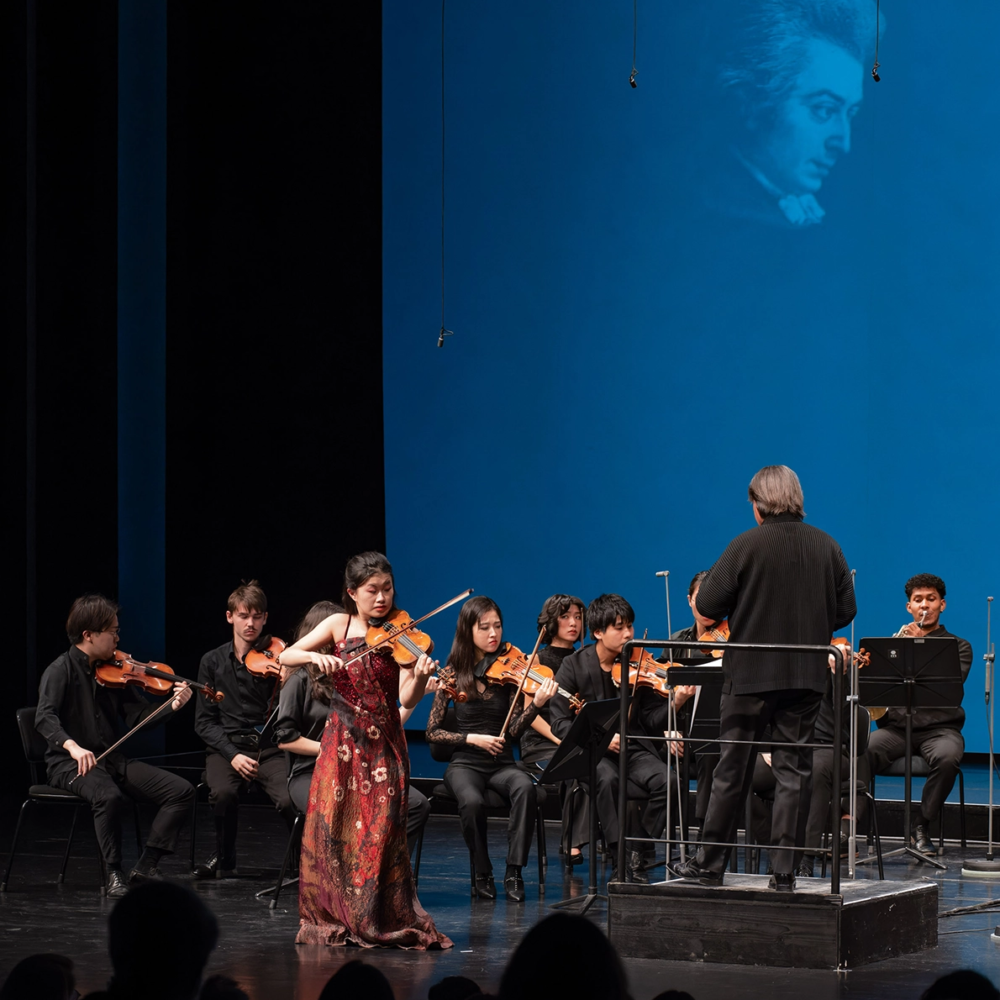
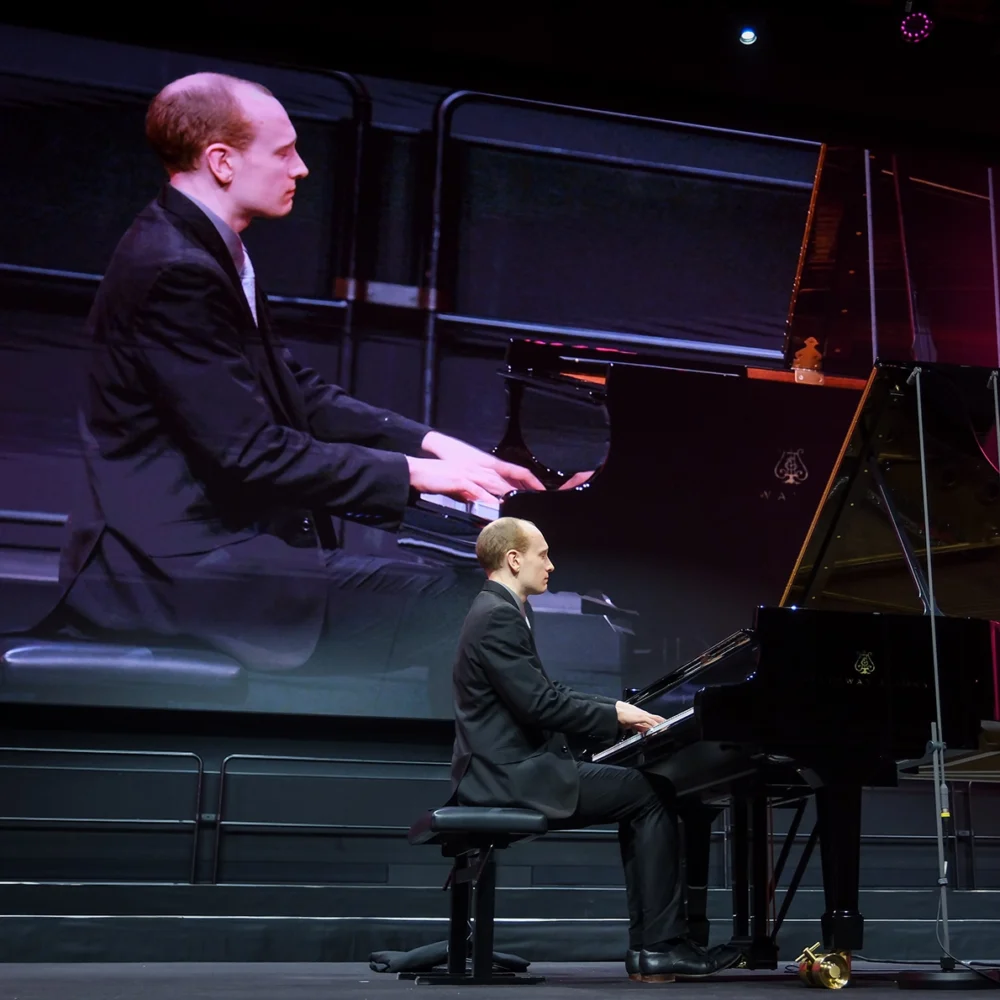
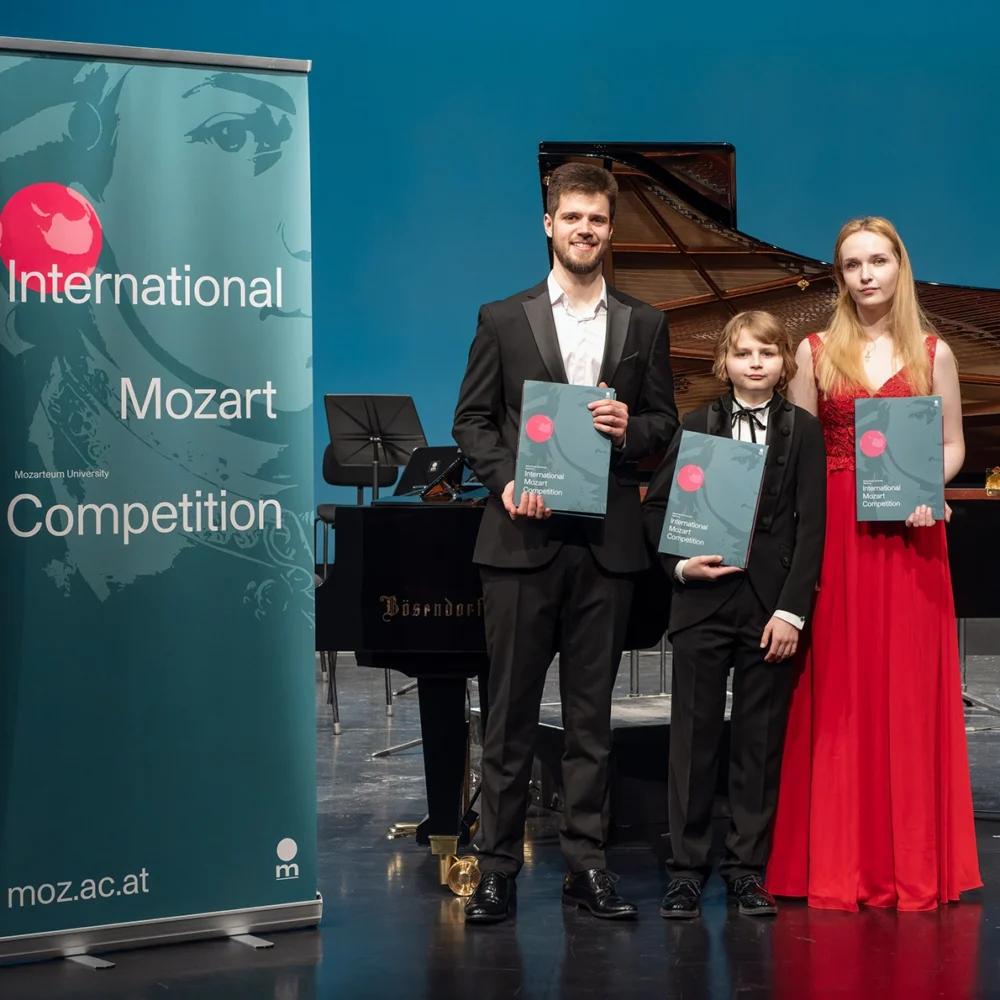
Bärenreiter donated special prizes at the International Mozart Competition in Salzburg (Photo: from left to right: Bogdan Dugalić, Elisey Mysin, Anastasiia Kliuchereva, photo: Michael Klimt)
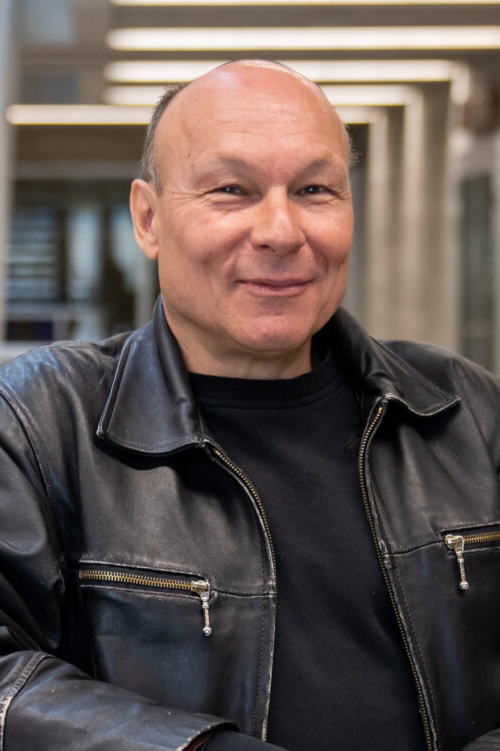
Dieter Ammann was born in Aarau in 1962. He grew up in a very musical family. After graduating from high school, he studied school music/conducting (Lucerne) and at the same time completed a course at the Swiss Jazz School in Bern. The 1980s and early 90s were characterized by Europe-wide concert activities and recordings in the field of jazz/improvised music, with artists as diverse as Eddie Harris (CD Yeah, you right) and Udo Lindenberg.
This was followed by studies in theory/composition at the Basel Music Academy (Roland Moser, Detlev Müller-Siemens) with courses with Witold Lutoslawski, Wolfgang Rihm, Dieter Schnebel and Niccolo Castiglioni.
At the age of 30, he turned to composition. Due to his scrupulous and slow approach to his work, a commissioned work can take two years or more to complete. He has received numerous national and international awards for his chamber music and orchestral works, including grants from the Aargau Board of Trustees, the Canton of Lucerne, the Franz Liszt Scholarship from the “Weimar European Capital of Culture” Foundation, the main prize from the IBLA Foundation New York (in honor of L. Berio) and the “Young composers in Europe” competition (Leipzig), the Ernst von Siemens Prize for Composition, the Swiss Music Prize and the AZ Media Prize for Culture.
Master classes have taken him to the universities of Cologne, Weimar, Karlsruhe, St. Petersburg, New York University, Rosario and La Plata, among others. He is in demand as a lecturer at the International Impulse Academy Graz or, together with Wolfgang Rihm, at the Composers Seminar of the Lucerne Festival Academy and leads a composition class at the Lucerne School of Music.
Ammann has received invitations as composer-in-residence to festivals such as the Davos Festival, Les Muséiques Festival, the Lucerne Festival, Wittener Tage für neue Kammermusik, Sommerliche Musiktage Hitzacker, the ReMusica Festival St. Petersburg, Tongyeong International Music Festival and the Weywuying Festival.
In addition to the renowned Swiss orchestras (Tonhalle, Philharmonia Zurich, Lucerne, Basel, Bern, Suisse Romande), his works have been performed by orchestras such as the Boston Symphony Orchestra, BBC Symphony Orchestra, Philharmonia London, Helsinki Philharmonic, Mariinsky Symphony, Munich Philharmonic, Vienna Symphony Orchestra, Munich Chamber Orchestra, DSO Berlin, WDR, Lucerne Festival Contemporary Orchestra, Klangforum Wien, Ensemble Modern Orchestra, Ensemble intercontemporain, Quatuor Diotima, Mondrian Ensemble, ensemble recherche, conducted by Pierre Boulez, George Benjamin, Jonathan Nott, Baldur Brönnimann, Sylvain Cambreling, James Gaffigan, Valery Gergiev, Pablo Heras-Casado, Susanna Mälkki, Sakari Oramo, Matthias Pintscher, Emilio Pomarico, David Robertson, Peter Rundel, Michael Sanderling, Markus Stenz, Mario Venzago and many others.
Artists such as Carolin Widmann, Andreas Haefliger, Michael Barenboim, Tabea Zimmermann, Nils Mönkemeyer, and Maximilian Hornung interpret his solo pieces and concertos.
Ammann’s works are published by Bärenreiter Verlag and Swiss Music Edition SME/musinfo.ch
| Komponist Vorname | Komponist Nachname | Titel | Datum | Orchester | Dirigent | Ort | Info |
|---|---|---|---|---|---|---|---|
| Beat | Furrer | Begehren | 03.12.2025 | Cantando Admont & Ensemble Écoute | Fernando Palomeque | Paris (Salle Cortot) | konzertant |
| Wolfgang Amadeus | Mozart | Messe in c-Moll | 04.12.2025 | Bergen Philharmonic Orchestra | Matthews Halls | Bergen (Grieghallen) | |
| Christoph Willibald | Gluck | Orfeo ed Euridice | 06.12.2025 | Guiliano Betta, Regie: Giuseppe Spota | Gelsenkirchen | Premiere | |
| Jonathan | Harvey | Tranquil Abiding | 07.12.2025 | Gürzenich-Orchester Köln | Sakari Oramo | Köln (Philharmonie) | |
| Wolfgang Amadeus | Mozart | Mitridate, Re di Ponto | 07.12.2025 | Leo Hussain, Regie: Claus Guth | Frankfurt | Premiere | |
| Georg Friedrich | Händel | Ariodante | 09.12.2025 | Stefano Montanari, Regie: Jetske Mijnssen | London (Royal Opera House) | Premiere | |
| Philipp | Maintz | haché für orgel solo, englouti für orgel solo | 09.12.2025 | Angela Metzger (Orgel) | München (musica viva, Herkulessaal der Residenz) | ||
| Lubica | Cekovská | ORNITHIC TALES for Woodwind Trio | 11.12.2025 | Trio Aperto | Brünn (Villa Löw-Beer) | Uraufführung | |
| George | Benjamin | Concerto for Orchestra | 12.12.2025 | Symphonieorchester des Bayerischen Rundfunks | George Benjamin | München (Residenz) | |
| Claudio | Monteverdi | L’incoronazione di Poppea | 12.12.2025 | Martin Schelhaas, Regie: Judith Lebiez | Schwerin | Premiere | |
| Charles | Gounod | Faust | 13.12.2025 | National Radio Choir, Radio Filharmonisch Orkest | Stéphane Denève | Amsterdam (Concertgebouw) | |
| Peter I. | Tschaikowsky | Schwanensee | 14.12.2025 | Sinfonieorchester Aachen | Christopher Ward | Amsterdam (Concertgebouw) | |
| Giselher | Klebe | Al Rovescio | 14.12.2025 | Ensemble Earquake | Merve Kazokoglu | Detmold (Hochschule für Musik) | |
| Wolfgang Amadeus | Mozart | Don Giovanni | 14.12.2025 | Francesco Corti, Regie: Tom Goossens | Gent | Premiere | |
| Philipp | Maintz | choralvorspiel II (rorate cæli desuper) für orgel solo | 14.12.2025 | Andreas Sieling (Orgel) | Berlin (Dom) | Uraufführung | |
| Jacques | Offenbach | Les contes d'Hoffmann | 16.12.2025 | Emmanuel Villaume, Regie: Damiano Michieletto | Lyon | Premiere | |
| Georges | Bizet | Carmen | 17.12.2025 | Jordi Bernacer, Regie: Stephen Medcalf | Bari (Teatro Petruzzelli) | Premiere | |
| Anton | Bruckner | 8. Symphonie | 18.12.2025 | Orquesta de la Comunitat Valenciana | Fabio Luisi | Valencia (Palau de Les Arts) | |
| Anders | Hillborg | Piano Concerto No. 2 | 18.12.2025 | Emanuel Ax (Klavier), Symphonieorchester des Bayerischen Rundfunks | Esa-Pekka Salonen | München (Residenz) | |
| Hector | Berlioz | L’enfance du Christ | 19.12.2025 | Netherlands Radio Choir, Radio Filharmonisch Orkest | Edward Gardner | Utrecht (Tivoli) | |
| Wolfgang Amadeus | Mozart | Così fan tutte | 20.12.2025 | Basil H. E. Coleman, Regie: Ultz | Passau | Premiere | |
| Guido | Masanetz | In Frisco ist der Teufel los | 21.12.2025 | Kai Tietje, Szenisches Arrangement: Martin G. Berger | Berlin (Komische Oper, Schillertheater) | Premiere | |
| Philipp | Maintz | choralvorspiel XIX (wie schön leucht’ uns der morgenstern) für orgel | 22.12.2025 | Max Carsley (Orgel) | Salisbury (Cathedral) | auch 23.12. | |
| Georg Friedrich | Händel | Das Alexanderfest oder Die Macht der Musik | 31.12.2025 | Heinrich-Schütz Ensemble, Barockorchester St. Martin | Eckhard Manz | Kassel (Martinskirche) | |
| Anton | Bruckner | 4. Symphonie | 08.01.2026 | Wiener Symphoniker | Philippe Jordan | Wien (Konzerthaus) | |
| Anton | Bruckner | 5. Symphonie | 11.01.2026 | Sächsische Staatskapelle | Herbert Blomstedt | Dresden (Semperoper) | |
| L’ubica | Cekovska | Toy Procession | 15.01.2026 | Slovenská filharmónia | Juraj Valcuha | Bratislava (Philharmonie) | Slowak. Erstauff., auch 16.1. |
| Bohuslav | Martinu | Rhapsody-Concerto | 15.01.2026 | Antoine Tamestit (Viola), Antwerp Symphony Orchestra | Jonathan Bloxham | Gent (De Bijloke) | |
| Charlotte | Seither | Never real, always true für Akkordeon solo | 15.01.2026 | Margit Kern (Akkordeon) | Berlin (Heimathafen Neukölln, Ultraschall Festival) | ||
| Christoph Willibald | Gluck | Orfeo ed Euridice | 16.01.2026 | Ensemble Concerto München | Jordi Francés | Teneriffa (Auditorio) | konzertant |
| Georg Friedrich | Händel | Giulio Cesare in Egitto | 17.01.2026 | Carlo Benedetto Cimento, Regie: Chiara Osella, Carlo Massari | Salzburg (Landestheater) | Premiere | |
| Jules | Massenet | Werther | 19.01.2026 | Raphael Pichon, Regie: Ted Huffman | Paris (Opéra Comique) | Premiere | |
| Miroslav | Srnka | Emojis, Likes and Ringtones, Overheating for ensemble | 20.01.2026 | Ensemble Modern | Michael Wendeberg | Frankfurt (Oper) | |
| Beat | Furrer | Ira-Arca für Bassflöte und Kontrabass | 20.01.2026 | Kammerensemble Neue Musik Berlin | Berlin (Konzerthaus) | ||
| Anton | Bruckner | 7. Symphonie | 22.01.2026 | Borusan Istanbul Philharmonic Orchestra | Christoph Eschenbach | Istanbul (Lütfi Kirdar ICEC) | |
| Peter I. | Tschaikowsky | Schwanensee | 22.01.2026 | Nicola Giuliani, Choreographie: Jean-Sébastien Colau | Palermo (Teatro Massimo) | Premiere | |
| Ludwig van | Beethoven | Musik zu Goethes Trauerspiel Egmont | 22.01.2026 | Kammerorchester Basel | Giovanni Antonini | Olten (Stadttheater) | weitere Termine |
| Christoph Willibald | Gluck | Orfeo ed Euridice | 23.01.2026 | Fabio Biondi, Regie: Shirin Neshat | Parma | Premiere | |
| Wolfgang Amadeus | Mozart | Die Zauberflöte | 23.01.2026 | Philharmonia Chor Wien, Mozarteumorchester Salzburg | Roberto González-Monjas | Salzburg (Mozartwoche, Haus für Salzburg) | |
| Philipp | Maintz | der zerfall einer illusion in farbige scherben für orchester mit obligatem akkordeon | 23.01.2026 | Sinfonietta R?ga | Normunds Sn? | Riga (Liela Aula) | Lettische Erstaufführung |
| Jean-Philippe | Rameau | Platée | 24.01.2026 | Nicholas Kok, Regie: Anja Kühnhold | Hagen | Premiere | |
| Andreas N. | Tarkmann | Der Mistkäfer | 25.01.2026 | Clara-Schumann-Philharmoniker | Dionysis Pantis | Plauen (Vogtlandtheater) | |
| Peter I. | Tschaikowsky | Eugen Onegin | 26.01.2026 | Case Scaglione, Regie: Ralph Fiennes | Paris (Opéra National) | Premiere | |
| Hector | Berlioz | Benvenuto Cellini | 28.01.2026 | Alain Altinoglu, Regie: Thaddeus Strassberger | Brüssel | Premiere | |
| Andreas N. | Tarkmann | Nils Holgersson | 28.01.2026 | Cottbus (Staatstheater) | |||
| Anton | Bruckner | 4. Symphonie | 29.01.2026 | Jenaer Philharmonie | Mario Venzago | Jena (Volkshaus) | |
| Wolfgang Amadeus | Mozart | Don Giovanni | 30.01.2026 | Maximilian Otto, Regie: Dennis Krauß | Chemnitz | Premiere | |
| Wolfgang Amadeus | Mozart | La clemenza di Tito | 30.01.2026 | Kirill Karabits, Regie: Jean-Philippe Clarac & Olivier Deloeuil (le Lab) | Nizza | Premiere | |
| Antonín | Dvorák | Die Geisterbraut | 30.01.2026 | Opernchor, Hofer Symphoniker | Peter Kattermann | Hof | Premiere, konzertant |
| Wolfgang Amadeus | Mozart | Requiem | 31.01.2026 | Ivan Demidov, Choreographie: Peter Chu | Augsburg (Martini-Park) | Premiere | |
| Engelbert | Humperdinck | Königskinder | 31.01.2026 | Kenichiro Kojima, Regie: Lars Scheibner | Neustrelitz | Premiere | |
| Jules | Massenet | Werther | 31.01.2026 | Markus Merkel, Regie: Markus Dietze | Koblenz | Premiere | |
| Jacques | Offenbach | Les Contes d'Hoffmann | 31.01.2026 | Takahiro Nagasaki, Regie: Philipp Himmelmann | Lübeck | Premiere | |
| Georg Friedrich | Händel | Orlando | 02.02.2026 | Capella Cracoviensis | Thibault Noally | Krakau (ICE) | |
| Anton | Bruckner | 3. Symphonie | 05.02.2026 | Neubrandenburger Philharmonie | Marcus Bosch | Neubrandenburg (Konzertkirche) | weitere Termine |
| Christoph Willibald | Gluck | Orfeo ed Euridice | 05.02.2026 | Attilio Cremonesi, Regie: Carolin Pienkos, Cornelius Obonya | Klagenfurt | Premiere | |
| Hector | Berlioz | L’enfance du Christ | 06.02.2026 | Orquestra de la Comunitat Valenciana | Mark Elder | Castellón (Auditorio y Palacio de Congresos) | |
| Miroslav | Srnka | Superorganisms | 06.02.2026 | Ensemble Modern, hr-Sinfonieorchester | Sylvain Cambreling | Frankfurt (cresc… Biennale für aktuelle Musik) | |
| Georg Friedrich | Händel | Giulio Cesare in Egitto | 07.02.2026 | Basil H.E. Coleman, Regie: Stephen Medcalf | Passau | Premiere | |
| Wolfgang Amadeus | Mozart | Die Entführung aus dem Serail | 07.02.2026 | Jochem Hochstenbach, Regie: Holger Potocki | Trier | Premiere | |
| Georges | Bizet | Carmen | 07.02.2026 | Keri-Lynn Wilson, Regie: Calixto Bieito | Paris (Opéra Bastille) | Premiere | |
| Peter I. | Tschaikowsky | Eugen Onegin | 07.02.2026 | Christopher Ward, Regie: Verena Stoiber | Aachen | Premiere | |
| Anton | Bruckner | 9. Symphonie | 13.02.2026 | Sächsische Staatskapelle | Daniele Gatti | Dresden (Semperoper) | |
| Matthias | Pintscher | Verzeichnete Spur | 13.02.2026 | Mannes School of Music | David Fulmer | New York (New School Tishman Auditorium) | |
| Wolfgang Amadeus | Mozart | Don Giovanni | 14.02.2026 | Daniele Squeo, Regie: Christoph Dammann | Kaiserslautern | Premiere | |
| Wolfgang Amadeus | Mozart | Idomeneo | 14.02.2026 | Gerrit Prießnitz, Regie: Henry Mason | Innsbruck (Tiroler Landestheater) | Premiere | |
| Eric | Coates | Calling All Workers | 15.02.2026 | Jenaer Philharmonie | Daniel Spaw | Jena (Volkshaus) | |
| Pietro Mascagni / | Ruggero Leoncavallo | Cavalleria Rusticana/Pagliacci | 15.02.2026 | Alma Deutscher, Regie: Shawna Lucey | San José (California Theatre) | Premiere | |
| Andreas N. | Tarkmann | König Karotte | 18.02.2026 | Cottbus (Staatstheater) | |||
| Anton | Bruckner | 8. Symphonie | 19.02.2026 | Philharmonia Orchestra | Donald Runnicles | London (Royal Festival Hall) | |
| Georges | Bizet | Les Pêcheurs de Perles | 20.02.2026 | David Stern, Regie: N.N. | Palm Beach (Kravis Center) | Premiere | |
| Thomas | Adès | Violin Concerto | 20.02.2026 | Leila Josefowicz (Violine), Tonhalle Orchester | Pierre-André Valade | Zürich (Tonhalle) | |
| Georg Friedrich | Händel | Tamerlano | 20.02.2026 | René Jacobs, Regie: Kobie van Rensburg | Karlsruhe (Internationale Händel-Festspiele) | Premiere | |
| Wolfgang Amadeus | Mozart | Die Zauberflöte | 20.02.2026 | St. Louis Symphony Orchestra | Stéphane Denève | St. Louis (Powell Hall) | konzertant |
| Bedrich | Smetana | Mein Vaterland | 22.02.2026 | Staatsorchester Stuttgart | Dennis Russel Davies | Stuttgart (Liederhalle) | |
| Georg Friedrich | Händel | Giulio Cesare in Egitto | 28.02.2026 | Marc Minkowski, Regie: Vincent Boussard | Valencia (Palau de les Arts) | Premiere | |
| George | Benjamin | Written on Skin | 01.03.2026 | Erik Nielsen, Regie: Tatjana Gürbaca | Frankfurt | Premiere | |
| Georg Friedrich | Händel | Rinaldo | 02.03.2026 | Les Arts Florissants | Paul Agnew | Paris (Philharmonie) | konzertant |
| Andreas N. | Tarkmann | Der Mistkäfer | 03.03.2026 | Philharmonisches Staatsorchester Mainz | Mainz | weitere Termine | |
| Joseph | Haydn | Die Sieben letzten Worte unseres Erlösers am Kreuz | 07.03.2026 | Ensemble Resonanz | Riccardo Minasi | Amsterdam (Concertgebouw) | auch 8.5. Hamburg |
| Peter I. | Tschaikowsky | Schwanensee | 07.03.2026 | Gerrit Prießnitz, Choreographie: Marcel Leemann | Innsbruck (Tiroler Landestheater) | Premiere | |
| Wolfgang Amadeus | Mozart | Ascanio in Alba | 10.03.2026 | Les Talens Lyriques | Christophe Rousset | Wien (Theater an der Wien) | weitere Termine |
| Wolfgang Amadeus | Mozart | Idomeneo | 10.03.2026 | Enrico Onofri, Regie: Calixto Bieito | Brüssel | Premiere | |
| Georg Friedrich | Händel | Giulio Cesare in Egitto | 11.03.2026 | Gianluca Capuano, Regie: Davide Livermore | Zürich | Premiere | |
| Wolfgang Amadeus | Mozart | Die Zauberflöte | 13.03.2026 | Laurent Brack, Regie: Ned Grujic | Courbevoie (LabOpéra Hauts-de-Seine) | Premiere | |
| Christoph Willibald | Gluck | Die Lieben der Berenice | 14.03.2026 | Andreas Spering, Choreographie: Anton Lachky | Luzern | Premiere | |
| Christoph Willibald | Gluck | Orfeo ed Euridice | 14.03.2026 | Lorenz Höß, Regie: Inga Schulte | Koblenz (Theaterzelt) | Premiere | |
| Claudio | Monteverdi | L’incoronazione di Poppea | 14.03.2026 | Takahiro Nagasaki, Regie: Johannes Pölzgutter | Lübeck | Premiere | |
| Wolfgang Amadeus | Mozart | Die Zauberflöte | 14.03.2026 | Gabriel Venzago, Regie: Dominik Wilgenbus | Mainz | Premiere | |
| Christoph Willibald | Gluck | Iphigénie en Tauride | 14.03.2026 | André de Ridder, Regie: Caterina Cianfarini | Freiburg | Premiere | |
| Anton | Bruckner | 4. Symphonie | 16.03.2026 | Orchestre de l'Opéra national de Paris | Marek Janowski | Paris (Opéra National) | |
| Georg Friedrich | Händel | Aci, Galatea e Polifemo | 20.03.2026 | Orchester Opernhaus Zürich | Philippe Jaroussky | Zürich | konzertant |
| Wolfgang Amadeus | Mozart | La finta giardiniera | 21.03.2026 | Christopher Schumann, Regie: Brigitte Fassbaender | Nürnberg | Premiere | |
| Georg Friedrich | Händel | Alcina | 21.03.2026 | Andreas Kowalewitz, Regie: Manuel Schmitt | Regensburg | Premiere | |
| Andreas N. | Tarkmann | König Karotte | 22.03.2026 | Thilo Prothmann (Sprecher), Jenaer Philharmonie | Magdalena Klein | Jena (Volksbad) | |
| Wolfgang Amadeus | Mozart | La finta giardiniera | 24.03.2026 | Chloé Dufresne, Regie: Julie Delille | Paris (Opéra National) | ||
| Wolfgang Amadeus | Mozart | Don Giovanni | 27.03.2026 | David Behnke, Regie: Mascha Pörzgen | Greifswald (Stadthalle) | Premiere | |
| Georg Friedrich | Händel | Belshazzar | 28.03.2026 | George Petrou, Regie: Herbert Fritsch | Berlin (Komische Oper) | Premiere | |
| Claudio | Monteverdi | L'Incoronazione di Poppea | 28.03.2026 | Sebastiaan Eben van Yperen, Regie: André Bücker | Augsburg (Martini-Park) | Premiere | |
| Hector | Berlioz | Grande messe des morts | 02.04.2026 | Helsinki Music Centre Choir, Finnish Radio Symphony Orchestra | Nicholas Collon | Helsinki (Music Centre) | |
| Georg Friedrich | Händel | Il Trionfo del Tempo e del Disinganno | 07.04.2026 | Gianluca Capuano, Regie: Robert Carsen | Rom (Teatro Costanzi) | Premiere | |
| Dieter | Ammann | The Piano Concerto (Gran Toccata) | 10.04.2026 | Orli Shaham (Klavier), National Taiwan Symphony Orchestra | David Robertson | Kaohsiung (Weiwuying International Music Festival) | Taiwanesische Erstaufführung |
| Engelbert | Humperdinck | Königskinder | 11.04.2026 | Jochem Hochstenbach, Regie: Eike Ecker | Trier | Premiere | |
| Jean-Philippe | Rameau | Castor et Pollux | 11.04.2026 | Bernhard Forck, Regie: Nanine Linning | Graz | Premiere | |
| Anton | Bruckner | 4. Symphonie | 16.04.2026 | Gewandhausorchester | Herbert Blomstedt | Leipzig (Gewandhaus) | |
| Dieter | Ammann | Le réseau des reprises pour grand ensemble | 16.04.2026 | Weiwuying Contemporary Music Ensemble | Jean-Philippe Wurtz | Kaohsiung (Weiwuying International Music Festival) | Taiwanesische Erstaufführung |
| Matthias | Pintscher | Transir | 17.04.2026 | Emmanuel Pahud (Flöte), Orchestre Philharmonique de Radio France | Matthias Pintscher | Paris (Maison de la Radio et de la Musique) | |
| Wolfgang Amadeus | Mozart | Così fan tutte | 17.04.2026 | Federico Maria Sardelli, Regie: Mario Martone | Cagliari | Premiere | |
| Georg Friedrich | Händel | Messiah | 17.04.2026 | Patrick Summers, Regie: Robert Wilson | Houston (Wortham Theatre) | Premiere | |
| L’ubica | Cekovska | Dorian Gray | 18.04.2026 | Dieter Klug, Regie: Heiko Henschel | Annaberg-Buchholz | Premiere | |
| Dieter | Ammann | pRESTo sOSTINAto for ensemble | 18.04.2026 | Weiwuying Contemporary Music Ensemble | Jean-Philippe Wurtz | Kaohsiung (Weiwuying International Music Festival) | Taiwanesische Erstaufführung |
| Christoph Willibald | Gluck | Orphée et Euridice | 22.04.2026 | Nicole Paiement, Regie: Amanda Testini | Victoria (Pacific Opera) | Premiere | |
| Beat | Furrer | Piano Concerto No. 2 | 24.04.2026 | Francesco Piemontesi (Klavier), Symphonieorchester des Bayerischen Rundfunks | Enno Poppe | München (Residenz) | |
| Wolfgang Amadeus | Mozart | Così fan tutte | 24.04.2026 | Emily Senturia, Regie: Haley Stamats | Madison (Overture Hall) | Premiere | |
| Claudio | Monteverdi | L’incoronazione di Poppea | 26.04.2026 | Lars Ulrik Mortensen, Regie: Christoph Marthaler | Kopenhagen (Det Kongelige Teater) | Premiere | |
| Wolfgang Amadeus | Mozart | La clemenza di Tito | 26.04.2026 | Marc Minkowski, Regie: Damiano Michieletto | Zürich | Premiere | |
| Beat | Furrer | Studie IV für Klavier solo | 28.04.2026 | Filippo Gorini (Klavier) | Mailand (Teatro alla Scala) | Italienische Erstaufführung | |
| Andreas N. | Tarkmann | Wesendonck-Lieder | 30.04.2026 | Alicja Bukowska (Mezzosopran), Elbland Philharmonie Sachsen | Hermes Helfricht | Pirna (Marienkirche) | |
| Georges | Bizet | Carmen | 01.05.2026 | Lorenzo Passerini, Regie: Nadja Loschky | Dresden | Premiere | |
| Wolfgang Amadeus | Mozart | Così fan tutte | 02.05.2026 | Yi-Chen Lin, Regie: Barbara-David Brüesch | St. Gallen | Premiere | |
| Claudio | Monteverdi | L'Orfeo | 02.05.2026 | Jörg Halubek, Regie: Markus Bothe | Schwetzingen (Schwetzinger SWR Festspiele, Schlosstheater) | Premiere | |
| Anton | Bruckner | 7. Symphonie | 05.05.2026 | Wiener Symphoniker | Marie Jacquot | Wien (Konzerthaus) | |
| Christoph Willibald | Gluck | Orphée et Euridice | 05.05.2026 | Edward Ananian Cooper, Regie: Pierre-André Weitz | Limoges | Premiere | |
| Christoph Willibald | Gluck | Paride ed Helena | 07.05.2026 | Akademie für Alte Musik | Michael Hofstetter | Augsburg (Internationale Gluck-Opern-Festspiele) | konzertant, weitere Termine |
| Peter I. | Tschaikowsky | Schwanensee | 08.05.2026 | Svetoslav Borisov, Choreographie: Stefano Giannetti | Dessau | Premiere | |
| Wolfgang Amadeus | Mozart | Idomeneo | 09.05.2026 | Julia Jones, Regie: Robert Carsen | Kopenhagen (Det Kongelige Teater) | Premiere | |
| Wolfgang Amadeus | Mozart | Die Zauberflöte | 09.05.2026 | Gregor Bühl, Regie: Nora Krahl | Gelsenkirchen | Premiere | |
| Hector | Berlioz | La damnation de Faust | 10.05.2026 | Orchester Opernhaus Zürich | Yves Abel | Zürich | konzertant |
| Philipp | Maintz | maintenant. pas encore. plus jamais. zweites streichquartett | 15.05.2026 | Quator Diotima | Linz (festival 4020, Brucknerhaus) | Österr. Erstaufführung | |
| Ludwig van | Beethoven | Fidelio | 16.05.2026 | The Cleveland Orchestra | Franz Welser-Möst | Cleveland (Mandel Concert Hall) | konzertant |
| Emmanuel | Chabrier | L’Etoile | 17.05.2026 | Nicolas Kruger, Regie: Matthew Eberhardt | Eindhoven (Parktheater) | Premiere | |
| Winfried Zillig: Rosse / | Ruggero Leoncavallo: Pagliacci | 17.05.2026 | Mark Rohde, Regie: Roman Hovenbitzer | Würzburg (Theaterfabrik Blaue Halle) | Premiere | ||
| Georges | Bizet | Le Docteur Miracle | 17.05.2026 | Anton Legkii, Regie: Claudia Plaßwich | Mannheim | Premiere | |
| Jules | Massenet | Werther | 20.05.2026 | Lorenzo Passerini, Regie: Willy Decker | Neapel | Premiere | |
| Hector | Berlioz | Grande messe des morts | 22.05.2026 | Paris Opera Choeurs et Orchestre | Philippe Jordan | Paris (Philharmonie) | |
| Wolfgang Amadeus | Mozart | Così fan tutte | 22.05.2026 | Dietger Holm, Regie: Magdalena Fuchsberger | Heidelberg | Premiere | |
| Hector | Berlioz | Grande messe des morts | 22.05.2026 | Orchestre et chœur Opéra National de Paris | Philippe Jordan | Paris (Philharmonie) | |
| Anton | Bruckner | 4. Symphonie | 24.05.2026 | Bamberger Symphoniker | Jakub Hrusa | Bamberg (Kirche St. Michael) | |
| Georges | Bizet | Carmen | 29.05.2026 | Keren Kagarlitsky, Regie: Wim Vandekeybus | Antwerpen | Premiere | |
| Frank | Martin | Messe für zwei vierstimmige Chöre a cappella | 30.05.2026 | Vocal ensembles ardent and suppléments musicaux | Patrick Secchiari, Moritz Achermann | Bern (Église francaise) | auch 31.5. |
| Bohuslav | Martinu | Zweimal Alexander | 02.06.2026 | Irene Delgado-Jiménez, Regie: Anna Bernreitner | Wien (Theater an der Wien) | Premiere | |
| Wolfgang Amadeus | Mozart | Die Entführung aus dem Serail | 03.06.2026 | Laurence Equilbey, Regie: Florent Siaud | Paris (Théâtre des Champs-Elysées) | Premiere | |
| Wolfgang Amadeus | Mozart | La clemenza di Tito | 09.06.2026 | Les Talens Lyriques | Christophe Rousset | Hampshire (The Grange Festival) | konzertant |
| Georg Friedrich | Händel | Alcina | 12.06.2026 | Claudio Novati, Regie: Felix Schrödinger | Detmold | Premiere | |
| Georg Friedrich | Händel | Il trionfo del Tempo e del Disinganno | 13.06.2026 | Simone De Felice, Regie: Katharina Kastening | Frankfurt (Bockenheimer Depot) | Premiere | |
| Wolfgang Amadeus | Mozart | Così fan tutte | 17.06.2026 | Leo Mc Fall, Regie: Marie-Ève Signeyrole | Wiesbaden | Premiere | |
| Wolfgang Amadeus | Mozart | Die Zauberflöte | 18.06.2026 | Janis Liepins, Regie: Cordula Däuper | Mannheim | Premiere | |
| Pietro Mascagni / | Ruggero Leoncavallo | Cavalleria Rusticana/Pagliacci | 19.06.2026 | Gábor Hontvári, Regie: Benjamin Prins | Sondershausen (Schloss) | Premiere | |
| Antonín | Dvorák | Rusalka | 19.06.2026 | Royal Liverpool Philharmonic Orchestra | Domingo Hindoyan | Liverpool (Philharmonic Hall) | konzertant |
| Thomas | Adès | Klavierkonzert | 24.06.2026 | Kirill Gerstein (Klavier), Tonhalle Orchester | Thomas Adès | Zürich (Tonhalle) | |
| Wolfgang Amadeus | Mozart | Die Entführung aus dem Serail | 27.06.2026 | Thomas Guggeis, Regie: Andrea Moses | Berlin (Staatsoper Unter den Linden) | Premiere | |
| Wolfgang Amadeus | Mozart | Idomeneo | 04.07.2026 | Felix Pätzold, Regie: Immo Karaman | Kiel | Premiere | |
| Giselher | Klebe | Mignon | 07.07.2026 | Detmolder Kammerorchester | Stanley Dodds | Detmold (Hochschule für Musik) |
The Swiss composer Dieter Ammann
takte: Dieter Ammann, what are the most important works you have composed to date? Have there been stages or turning points in your composing?
Ammann: I must begin by saying that it is important to me to develop a personal style, naturally not in order to repeat oneself, but rather in order to find a way in one’s chosen direction. There are a few turning points: one was after the first two pieces which were still characterised by serial thinking, “Developments” (1993) and “piece for cello” (1994/1998). In the cello piece the pitches are still treated very strictly, however, I was already working intuitively both rhythmically and in instrumental colour. And in its use of pitch, “Regard sur les traditions“ (1995) can also be easily explained. After that, it became more and more intuitive. In “The Freedom of Speech“ (1995/96), this freedom was already on the agenda, although the title is also concerned with the death of my father. Here for the first time, I have chosen a route which is sometimes laborious, of composing the introduction and developing what follows out of it.
Then for me, there are pieces where I’ve personally progressed: firstly ”Gehörte Form – Hommages“ (1998). I had seven months to work on this in Weimar, and this is reflected in the time dimensions and the tonal elaboration of these three string instruments. The next steps came a little later with “Violation“ (1998/99), where the relationship between solo instruments and ensemble was a central theme. Then come three orchestral pieces: in “Boost“ (2000/01), I unambiguously referred to “Grooves“ (2000), and in “Core“ (2002) I again referred to Boost. Finally, in the piano trio “Après le silence“ (2004/05) I have pushed the boundaries even further in the breadth of expression. Then bringing these extremes together under an arch, without the music dividing up, was a step forwards for me.
You’ve used terms such as scene change, that’s to say, you’ve used theatrical terms to describe your music. Many composers take literary works as inspiration, or works of fine art for the structure or emotional themes. Do you have such interests?
For me, music for me is exactly the medium which doesn’t need to convey any content apart from itself. I therefore don’t take such stimuli as my starting point. What I attempt is to translate my acoustic concept into a form which is also meaningful, or at least stimulating, for others. These are always pure acoustic perceptions, inherent musical events.
In your music, you frequently develop extreme contrasts of tension, juxtapose structures which form a rapid interplay – for instance between very energetic, eventful and very peaceful zones, and these build up from extremely complex stratified individual events.
This is connected with my personal fondness for fashioning from musical processes. I’m an impatient person and like it when I’m surprised, when as a listener, I’m alternately thrown onto a roller coaster of musical events and am carried away by it. Music which grabs my attention means more to me than something where I have to open seventeen doors before I can find out what it’s about, what the composer’s on about. That’s to say, when I write, then it’s always also for me as a listener, but that’s naturally a subjective process. At any rate, this curiosity and impatience has led to the fact that, with the exception of two pieces, I have stopped working with a material in long processes and examining it in all its facets. It’s much more the case that certain rules which I give myself, only apply selectively from time to time. When I notice that I would prefer a quite different acoustic outcome, I take some time off and modify or abandon the material. On the one hand this is a liberation, on the other hand you can’t hide behind the academic art of material treatment and illumination, because you have to decide make your own mind up whether this idea, this sound visualisation stands up to scrutiny and justifies itself. These are extremely subjectively located tonal concepts, which I then attempt to portray in a material most suitable to this concept. Therefore there are also tonal shapes in my mind, sometimes spaces in which dissonance and consonance are distinguishable – then once again the complete chromatic range up to quarter tones, which I then interpret as a further differentiation of the chromatic. I find it exciting to shape something direct, something haptic, and despite that to create musical depth in the spatial sense, so that with repeated listening you can perceive things behind it, which you were completely unaware of at first hearing.
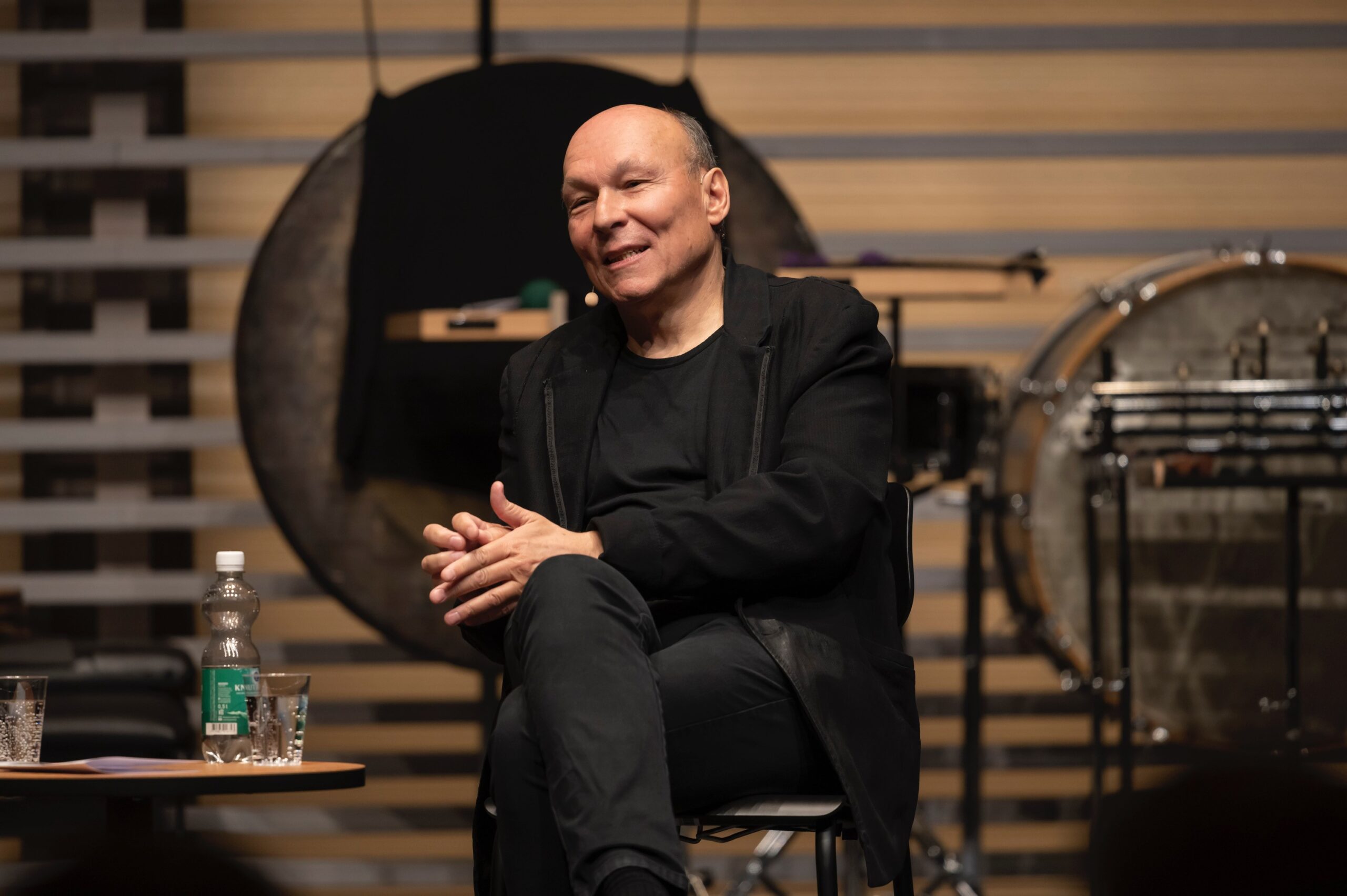
People probably often ask you about your interest in jazz. It’s clear that improvising is something other than composing. Despite that, there are indeed connections.
Through my father, who was a scientist and teacher, my approach to music was firstly through playing, then through listening. And even now, notation is always a distraction for me. I believe I have a different relationship to rhythmic aspects. There has been, and still is, a great deal of new music which is never allowed to pulsate. I no longer know exactly which composer made the remark that the problem with new music was that everything was rubato. In addition to this, people can tell my background as a performing musician from my treatment of instruments. It is important to me that, although the boundaries are tested in terms of playing technique, the music remains realisable. At the same time I have noticed that my intention very often coincides with the technical possibilities of the instrument, that I somehow feel and think out of the instrument. A characteristic of improvised music is also, that at almost every moment it is constructed as a dialogue. I also try to realise this principle of action-reaction in composed music between instrumental groups or individual instruments, and perhaps it also seems to be so lively for that reason.
Finally, a very general question: do you need to compose?
I actually began to compose because of an enquiry I received. I would never write without a commission. But, when I compose, I am so engrossed in it that a piece runs through my life for months, like a leitmotif. It can happen that I work for a year on fifteen minutes of music. I’m also a family man, love my children and wife very much, and am happy teaching. But when I compose, I can enter into a sound world for months, and meanwhile, I have a great need for that. Something else should be mentioned: I have the feeling that I have something to say in composed music, which others would say differently, or not say at all. I believe that I have something to contribute there, which is worth devoting myself to for the rest of my life. Indeed, I wasn’t a composer in the strict sense of the word until I was thirty years old, rather I was an interpreter, an instrumentalist. Naturally I developed pieces in bands, but that’s something other than “academic composing”. Here is something independent, which really contains something of me, something personal.
A brief look ahead: what are your next projects?
In the next few months, I’ll be busy on my second string quartet. In addition, my teaching commitments at the Musikhochschulen in Lucerne and Berne absorb a lot of time and energy. In spring 2009 I’ve accepted an invitation to be composer-in-residence at the Swiss festival ”les muséiques” and I’ll also be presenting my work as a musician in the Freefunk area. For 2010 another invitation from a major festival is lined up. With the commissioned work associated with this, I’m taking on a compositional task which I’ve already had in mind for a long time: to write a piece for orchestra which is calm for most of the time, and which is capable of forming a convincing trilogy with my two orchestral works Boost and Core.
In conversation with Marie Luise Maintz
from: takte 2/2008
Bärenreiter donated special prizes at the International Mozart Competition in Salzburg (Photo: from left to right: Bogdan Dugalić, Elisey Mysin, Anastasiia Kliuchereva, photo: Michael Klimt)
Bärenreiter donated special prizes at the International Mozart Competition in Salzburg
A life with Bach
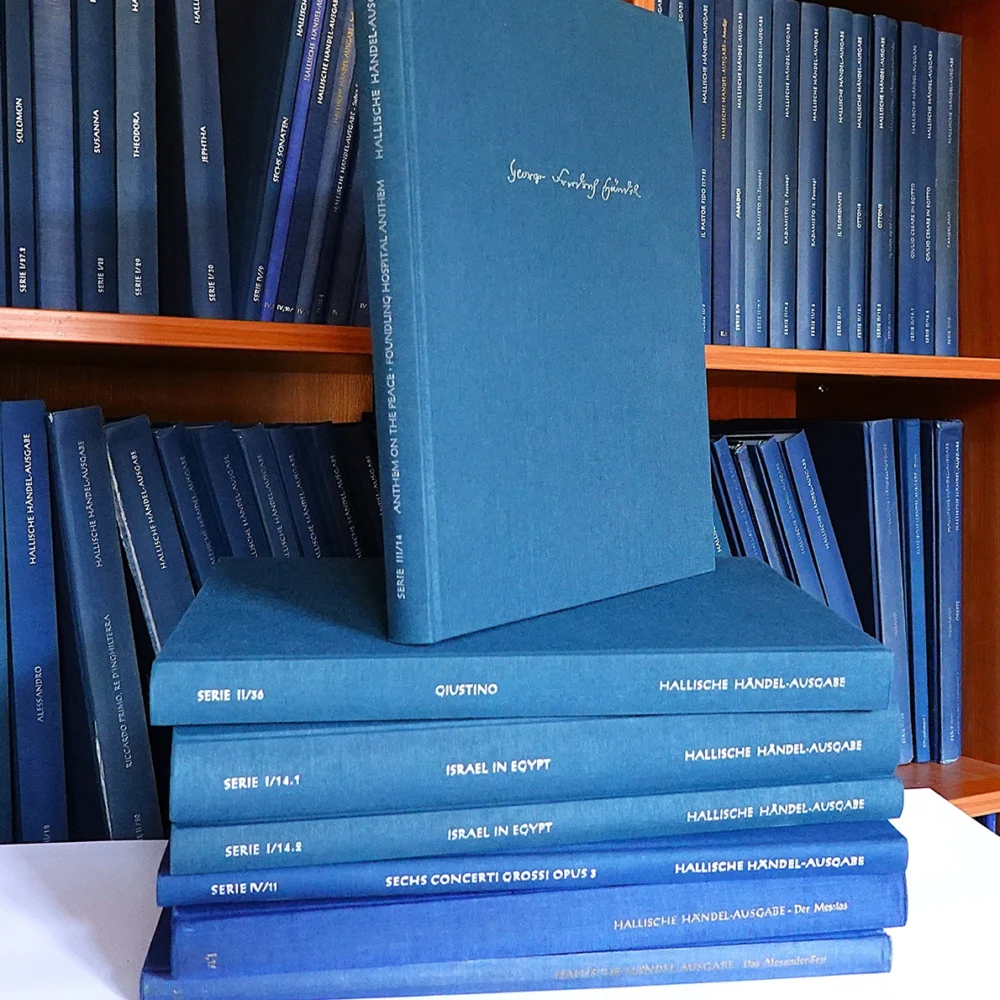
The 100th Volume of the Halle Handel Edition Has Been Published
The long-serving publisher and Chief Executive Officer of Schott Music, Peter Hanser-Strecker passed away
Piero Ostali, Owner and Managing Director of Casa Musicale Sonzogno, has died unexpectedly
English musicologist and conductor Jonathan Del Mar turns 75. His Beethoven editions opened a new chapter in the service of musical practice.
Bärenreiter donates special prizes at this prestigious piano competition in Beethoven’s birthplace, Bonn
Works by Andrea Lorenzo Scartazzini and Ľubica Čekovská will premiere in Bremen and Houston in November
The finalists of the German Conducting Award received special Bärenreiter prizes (pictured: Henri Christofer Aavik)
 SHOP
SHOP