
The Bärenreiter Urtext Colours

The covers of our URTEXT editions are colour-coded. You may have noticed that we assign a different colour to each composer whose works we publish – or almost every composer.
MOZART IS RED
BACH IS BLUE
… and so on.
We are often asked how we choose these colours.
The answer is simple: we get together and discuss it. We ask ourselves which colours we associate with a composer and their music.
In the end, the majority view prevails. Even so, the choice remains a subjective one, made by the Bärenreiter team.
SCHUBERT IS YELLOW
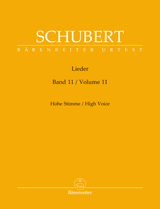
What colour could one possibly associate with Schubert’s music, given the richness and complexity of his oeuvre?
There are countless moments in which darkness, despair, and loneliness find expression. And yet, light so often emerges in the end. This light is not always radiant or joyful; more often, it is a spiritual or emotional illumination — a sense of solace that Schubert evokes through his masterful harmonies and subtle shifts of tonality.
It is this particular kind of light that we seek to capture in that warm shade of yellow.
SAINT-SAËNS IS VIOLET
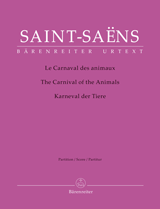
Camille Saint-Saëns lived through a century of dramatic upheaval in Europe. His long life (1835-1921) spanned revolutions, wars, and the reshaping of states and empires. At the same time his private life was not without tragedy; he lost two sons, both of whom died within six weeks of each other. However, Saint-Saëns kept this political and social turmoil as well as personal suffering out of his compositions. His musical style has a remarkable calmness and constancy about it.
In our view, the colour violet captures this feeling of tranquility and serenity particularly well.
DVOŘÁK IS ORANGE
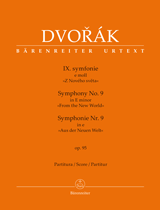
The passionate, “romantic” music of this composer calls for a warm colour—but one that also captures the liveliness and radiance found in the Czech folk elements of his work, with their syncopated rhythms and asymmetrical phrases. His music is never artificial; rather, it conveys a deep sense of sincerity. It moves between melancholy and optimism, between spirituality—as heard in the “Stabat Mater” and “Requiem”—and earthiness, as reflected in the many folk-inspired passages.
We chose a warm orange: the glowing hue of autumn leaves in late-summer light, perhaps like those Dvořák admired in September, the month of his birth.
DEBUSSY IS SKY-BLUE
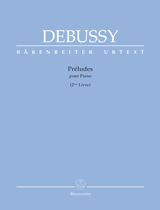
Claude Debussy—born on 22 August—was a child of summer. Many of his most iconic works seem more closely associated with that season than with the darker months of the year—most notably „Prélude à l’après-midi d’un faune”, but also “La Mer” and “Clair de lune”.
Debussy’s music often radiates lightness and transparency—qualities that are airy, sensual, and atmospheric. Assigning a single colour to the dazzling variety of his oeuvre may be impossible, but if one must choose, a bright summer sky blue seems particularly fitting.
JANÁČEK IS DARK PURPLE
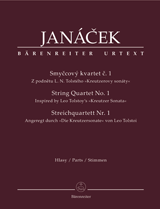
Janáček’s music is anything but “light”. The composer sought to express the deepest emotions with unflinching intensity.
In setting texts to music, he drew heavily on the natural rhythms and intonations of spoken Czech, aiming to convey the full meaning and emotional weight of the words. Short, incisive motifs—varied and developed in ever-changing ways—give his works a fragmented structure heightening restlessness and drama. This impression is amplified by rhythmic complexity: his music pulses with vitality, yet also often displays a distinct angularity and unpredictability. Janáček’s harmonic language is equally striking, marked by unexpected dissonances, abrupt chord shifts, and unusual progressions that generate a unique sense of atmosphere and emotional tension. His music doesn’t soar in celestial realms—it remains grounded and deeply connected to human experience.
A colour that could capture all of this? It could only be a deep, dark purple.
SCHUMANN IS SAGE-GREEN
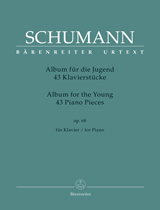
Schumann was certainly not a superficial character, but a reflective man who thought deeply about himself and others. Sensitive and psychologically vulnerable, he eventually suffered a mental breakdown. Is he the archetypal Romantic artist?
The Romantics had a special relationship with nature, in which green plays a central role. Schumann’s “Forest Scenes” immediately come to mind.
A deep green represents groundedness and inner harmony. Yet when it appears veiled, this sense of certainty begins to fade and grows more fragile.
BACH IS BLUE
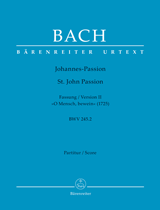
Doesn’t blue stand for clarity and sincerity? As a primary colour, it also conveys a sense of solidity, while at the same time maintaining a connection to the heavens. As such, it corresponds particularly well to the music of Johann Sebastian Bach, much of which was written for sacred purposes and which stands as one of the great cornerstones of European classical music.
BRAHMS IS OLIVE-GREEN
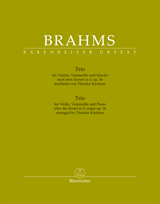
From photographs we know the older Brahms as a dignified gentleman with a full beard. He radiates a certain “Gemütlichkeit”, as we say in German—a word that is not easily translated, suggesting something between comfort and coziness.
And his music is warm and lyrical, yet also passionate, and undoubtedly rich in depth. Olive green seems a fitting choice for both the man and his music.
MOZART IS RED
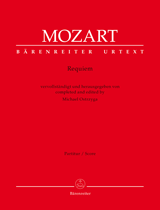
What do we associate with the colour red? Love and passion come to mind first. As one of the primary colours, it also represents vitality and clarity. Yet red has another side: it is the colour of danger and alertness, a colour that demands attention.
Isn’t red a fitting choice for Mozart’s music? A colour that captures both its vibrancy and its drama, as well as its depth. A distinctive, singular colour for one of the most outstanding composers in the history of Western music.
RAVEL IS LIME-GREEN
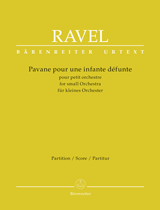
We associate freshness, lightness, and clarity with the colour lime-green. This colour seems to suit Ravel’s music well, which embodies all of these qualities. Atmospheric sound magic is juxtaposed with rhythmic drive and breathtaking virtuosity. Ravel moves marvellously between a certain “coolness and sensuality”, as the musicologist and composer Peter Cahn aptly puts it.
Some say—and we do not necessarily agree—that Ravel’s music is all surface sparkle, but what a surface it is.
