

BÄRENREITER URTEXT
What can I expect from a Bärenreiter urtext edition?
Alongside providing a trustworthy musical text as well as valuable historical and performance practice information, it is just as important that Bärenreiter Urtext editions must be practical, functional and geared towards musicians’ needs.
For this reason, Bärenreiter Urtext editions offer:
- A well-presented layout and a user-friendly format
- A high-quality engraving
- Page turns and cues in the best possible places
- For solo string works additional parts with fingering and bowing
- In the case of solo concertos and vocal scores straight-forward piano reductions
Additionally, our print editions are distinguished by:
- Fold-out pages where you need them
- Excellent print quality
- Superior paper which blocks out the glare of concert hall lights
- Reliable binding to ensure durability and withstand frequent use
- Solid, “Made in Germany” quality

Why Bärenreiter Urtext?
Think of the time you spend practising and rehearsing for lessons and concerts. Can you really be sure that the music you play from reflects what the composer wanted?
Indeed, works have always been edited reflecting the taste of the time, often leading to a gradual deviation from what the composer had in mind.
What we play from today, often comes from old, heavily edited or even faulty editions. How disappointing to realise that you have wasted your time and energy on a musical text you cannot trust.
With Bärenreiter Urtext editions you can have confidence in the validity of the musical text.
What is an Urtext edition?
Isn’t it just a copy of the autograph?
The label Urtext describes a musical text that reflects the composer’s intentions as much as possible. This often evokes the notion that all you need to do is transcribe the composer’s autograph into modern notation. Granted, in the case of some composers with messy handwriting this can be a hard enough task. But there is much more to it than just that. What if the autograph has not survived – and the only sources we have are posthumous, maybe even contradictory? What if the composer made corrections in the parts that were used for the first performance or in the proofs for the first edition? Or what if the composer revised the work for a later, different performance situation?
In these cases, other sources come into play which must be taken into consideration and the autograph cannot be the main source.
No cost or effort is spared by Bärenreiter when it comes to amassing and piecing together all the available information.
An indispensable part of every Urtext edition is the Critical Commentary where all editorial decisions and discrepancies between the sources are meticulously recorded. Only in this way can the true genius of the composer and his work be revealed.
Let’s take this as an example
Franz Schubert’s Symphony No. 4 (“Tragic”) was composed in 1816 and was first published in the 1880s by Johannes Brahms as part of the old Schubert Complete Edition.
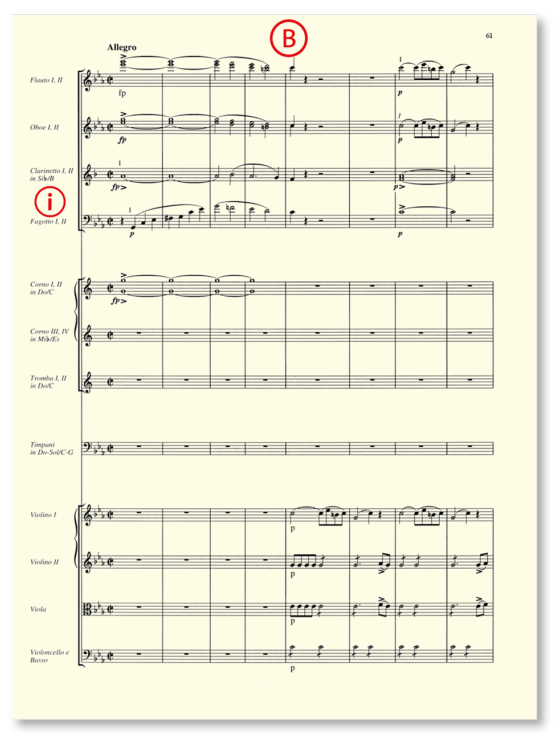
Here we have the 1st page of the last movement (A, the autograph page) where Schubert uses a musical motif called “the curtain”; the bassoon plays a soft upward moving melody (i), whereas all the other winds and horns play sustained tones. The dynamic is “piano”. This gives the impression that the orchestra is sitting behind a curtain, waiting for it to rise so that the performance can commence.
Either Brahms did not realise what this “curtain” technique was and assumed that Schubert had not fully completed the beginning of this movement or he did not approve of it. Whatever the reason, Brahms wrote “beide Fagotti”/“both bassoons“ above the melody (ii) and also copied this melody into the part for the violoncelli (iii), thus, in his mind, giving the music more impact.
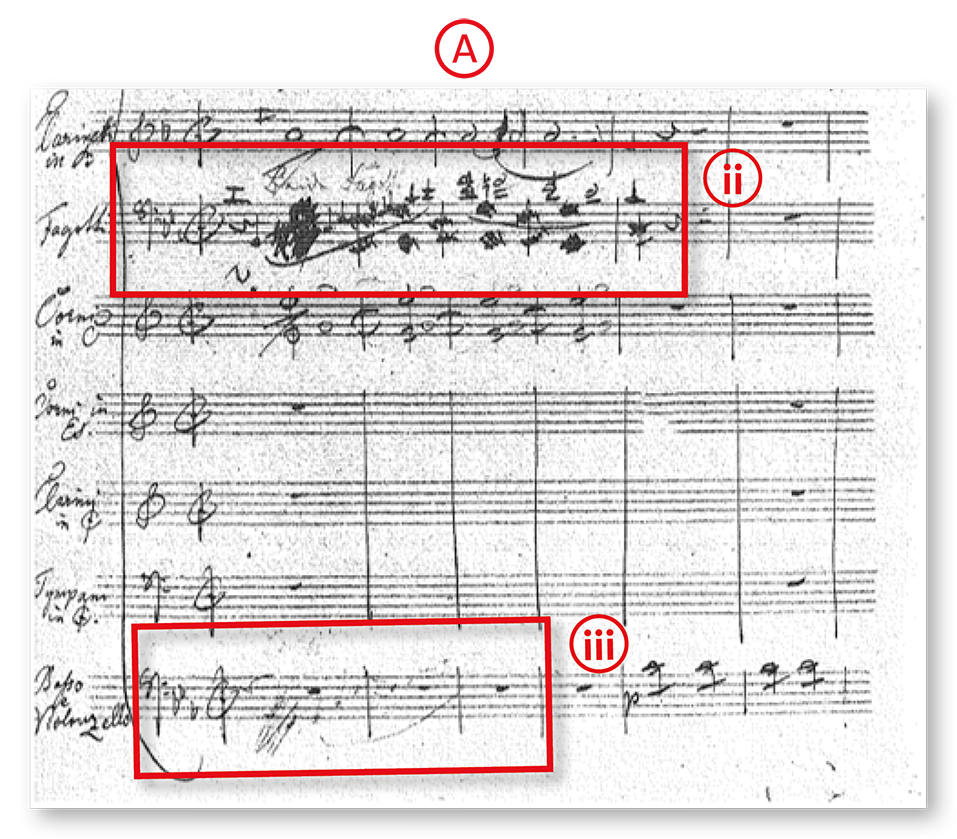
This first edition provided the only available musical text until 1990 when Bärenreiter published the symphony in the New Schubert Edition.
Our Urtext edition (BA05604) reinstates what Schubert originally intended (B). The music has been “stripped back” and is presented without the melody in the violoncelli and the second bassoon. It now has a completely different effect.
So, the Bärenreiter Urtext edition gives justice to Schubert’s intention for the first time.
Why does performance practice matter…
… even if you are playing on a modern instrument?
Did you know that musical symbols that are very familiar to you might have changed their meaning over time? For example, while today a crescendo fork clearly means to gradually get louder, 150 years ago it could additionally imply to speed up a little.
For hundreds of years composers have pretty much used the same musical symbols. What has rapidly changed throughout history, though, is what these symbols meant to composers and musicians. It requires knowledge about historical contexts and performing conventions to read and understand composers’ manuscripts correctly. What were these conventions at a particular time and for a particular composer regarding rhythm, timing and agogic shadings, what was meant by dots and strokes and various symbols for accentuations, how were arpeggios executed, what would have been perceived as appropriate vibrato, or what was expected in terms of ornamentation and improvisation?
Bärenreiter seeks to recover the messages and performing practices that composers understood their notations to convey to performers. To this end many of our Urtext editions include information on performance practice. Even if you are playing on a modern instrument, this information will give you insights into the very essence of the music itself as the composer conceived it.
Think of your next performance
Bärenreiter regularly updates editions to reflect new discoveries and research. With outdated editions or non-Urtext editions, many of which are free downloads or illegal copies, you miss out. Your performances miss out.
Build your personal music library with Bärenreiter Urtext editions.
Make our print and digital editions your own. Take advantage of our expertise and complement it with your personal markings and comments which you will be able to refer to all your life.
Make a Bärenreiter Urtext edition a life-time investment.
You can find more detailed information about our Urtext in this article.
